SAVE Chart
Serial Approval Vote Election (SAVE)
A new voting system for finding consensus
SAVE Chart
The Serial Approval Vote Election Algorithm
This page presents the SAVE algorithm. It is based around the Drakon-style flowchart in Figure 1. You can find an overview at the Wikipedia page for DRAKON, and much more information from the Drakon-editor page at Sourceforge.
The flow starts at the oval start icon at the upper left, with the text "Serial Approval Vote Election" and finishes at the oval end icon at the lower right with the text "end". There are four main columns in the diagram with a pentagonal headline icon at the top of each column. The rectangular action icons show things that are done, and the hexagonal question icons are decision points that direct the flow down one of two paths. The insertion icon labeled "Set Next Focus" has extra side lines and indicates a reference to another diagram, (the referenced diagram is under the "Exact Next Focus Selection Algorithm" heading below). The main flow direction is down, until you reach the pentagonal address icon at the bottom of each continuing column (i.e. all but the "end"). The address icon gives the name of the headline icon at the top of the next column to go to. To find the next column, go down to the thick horizontal line, head left to the thick vertical line, follow it up to the top thick line, and move to the column with the indicated headline.
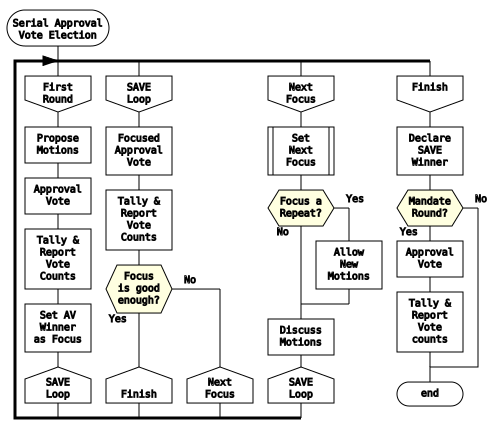
Figure 1: Overview of SAVE process.
First Round: Selecting the First Focus ,,fold,,
The first round of SAVE looks mostly like a normal election, albeit using approval voting instead of plurality voting. The steps are:
- Propose Motions
- This is where our initial motions are proposed. Each motion is registered in the order it was proposed. There is a single master list of all the motions, ordered by the time proposed.
- Approval Vote
- As a reminder, an approval vote ballot lists all the alternatives and voters are simply asked to vote for all the motions they approve of.
- Tally & Report Vote Counts
- The tally is very straightforward. Voters have marked all the motions they approve of, and when tallying, a check mark on a ballot counts as one vote for the corresponding motion. Every motion receives between 0 and the total number of ballots for its individual totals. The motion with the most votes wins.
- Set AV Winner as Focus
- Here is where SAVE starts to deviate from other methods. Winning the first round just means the winning motion will be the focus of the next round, the first round in the SAVE Loop.
In the unlikely event of a tie, the tie-breaking rule is quite simple. Ties are resolved by registration order, with earlier motions having preference.
SAVE Loop: iteration for better outcomes ,,fold,,
Once the first round is done, we have our first focus motion to start the SAVE Loop. There is always a delay between successive rounds that will vary according to the scope and scale of the overall election. This could be as short as a few minutes when the electorate is present or online and active, or a week or two when communication with the electorate is slow or the motions are very complex.
- Focused Approval Vote
- The ballot for a focused approval vote is very
similar to a regular approval vote ballot. Every motion is listed, and
each one has a checkbox. However, instead of being asked for approval,
voters are asked two slightly different things:
- For all non-Focus motions
- Voters are asked to vote for any and all motions they prefer over this round's focus motion.
- For the Focus motion
- Voters are asked whether they want to stop the SAVE Loop with this focus as the final winner.
- Tally & Report Vote Counts
- The exact same method is used to count the ballots as before. All the checked boxes are counted as votes for their respective motions, and the totals are reported.
- Focus is good enough?
- Once the votes for the round are in this
question is answered based on the vote counts:
- Yes
- If a strict majority of the voters voted to end the process, and that total vote count is larger than the individual vote counts of every non-focus motion, the SAVE Loop ends and this round's focus motion is now good enough.
- No
- This round's focus motion has not been accepted by the electorate. The result will be another focused approval vote round, which may or may not have a new focus motion.
There are only two possible outcomes of a focused approval vote round: either the focus motion is accepted as the final winner, or there will be another cycle through the SAVE Loop.
Next Focus: / Preparing for Next Round ,,fold,,
If the focus is not accepted by the electorate in the latest round, there will be another round. Depending on the latest results, the focus may change to another motion, and new motions may be allowed.
- Set Next Focus
- If the current focus is a Condorcet winner, it remains as the focus, even if one or more motions tied it. If it is not a Condorcet winner, the focus will change for the next round. (Exact focus selection algorithm in next subsection.)
- Focus a Repeat?
- If the next focus motion has been a focus in a
previous round, the the answer will be Yes. This happens when the
focus motion is a Condorcet winner, or when there is a majority cycle.
(Since there are a finite number of motions, a repeat will happen one
way or the other, unless a focus motion is accepted by the electorate
before any repeats occur.) If the next focus motion has not previously
been a focus, the answer is No.
- Yes
- Whenever the focus is a repeat (and only when it is a repeat), voters are allowed to propose new motions. The exact details of this expedited proposal process will vary with the scope and scale of the overall election. The goals are: to register new motions, to prevent duplicate motions, and to minimize any delay before the next round of voting.
- No
- No proposals will be accepted for this coming round. The reason for this is until a focus is repeated it is not clear which of the current motions is best (a Condorcet winner) or what the motions are in the top cycle. Only when the focus is a repeat do we have enough data to propose a motion that might be better than all the others.
- Discuss Motions
- This is a period during which voters have time to consider the results of the previous rounds, to consider the performance of existing motions, and to learn about any new motions. It is a time to campaign for or against any of the various motions, hoping to change voter opinions.
Once the Discuss Motions period has ended, the next round of voting will commence. (I.e. back to SAVE Loop.)
Exact Next Focus Selection Algorithm ,,fold,,
This second Drakon flowchart in Figure 2 expands the "Set Next Focus" action from Figure 1. Like the first, it starts and ends with oval icons, and has both action and question icons. It also has a Begin of FOR loop icon that looks like a rectangle with the top corners cut off, and a corresponding End of FOR loop icon looking like a rectangle with the bottom corners cut off. There are also Choice icons that look like parallelograms, and corresponding Case icons that look like a rectangle on top of a triangle and indicate the appropriate paths for their choices.
This is the procedure for determining the focus motion for the next round.
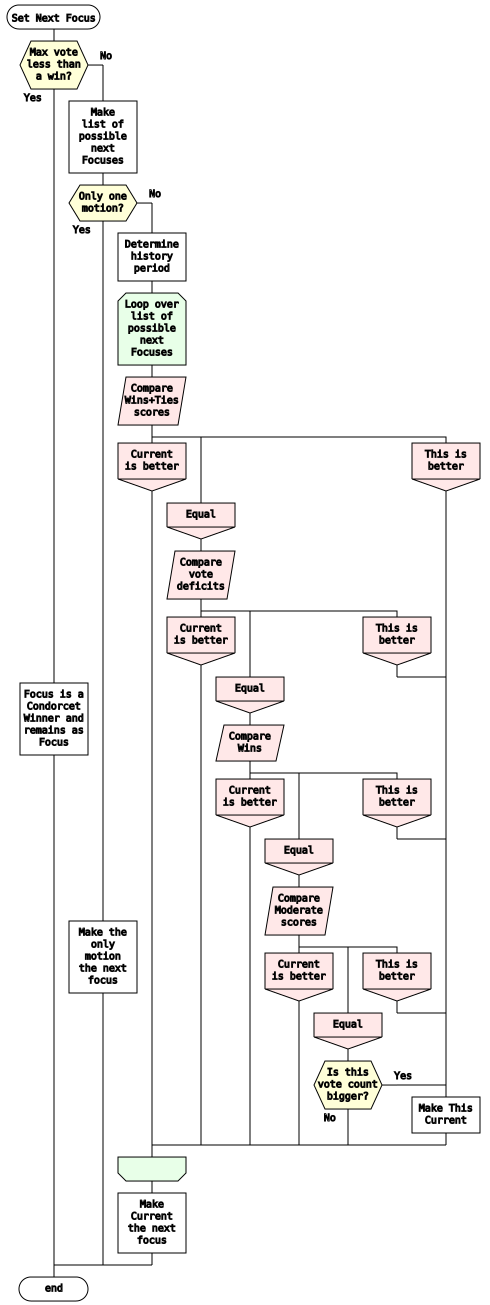
Figure 2: Details on how to select the next focus motion.
Note 1: If you are using the flowchart, I recommend you open it in another tab and move that tab to another window. That way you have a visible overview of the process to help with the text. However, the text includes all the details of the process and should be enough to understand it.
Note 2: We are presenting this process to be completely transparent, but we should make clear that this is a mechanical procedure that would either be automated or done by the people running the election. There is no particular reason for voters to understand these details in order to participate in the election. This process is detailed here so observers (or participants) can audit the process.
At the start of "Set Next Focus" we have current vote counts for every motion, the vote count for the focus (i.e. the vote count to stop the loop), the vote counts for all prior rounds, and the current non-focus motion max vote count. We also know, because the focus motion is not "good enough" yet, that the vote count for this most recent focus motion is either less than or equal to half the number of ballots cast, or less than or equal to the maximum non-focus vote count for this round.
- Max vote less than a win?
- If no non-focus motion receives more than
half the possible votes, the best any motion could do is tie the focus.
- Yes
- This focus motion is a Condorcet winner, and is in some sense the best of the current motions. It will remain as the focus for the next round, and the "Set Next Focus" sub-process returns to the main flowchart.
- No
- The focus motion is not a Condorcet winner, and so the focus motion will change. Continue with the next step.
- Make list of possible next Focuses
- The list of possible next focuses includes all motions that did not lose to the focus motion, which is to say each motion in this list was checked on at least half of the ballots cast, and at least one motion received a strict majority of the possible votes. This list is processed in registration order, starting with the earliest qualifying motions.
- Only one motion?
- If there is only one qualifying motion, then Yes.
Otherwise No.
- Yes
- When there is only one motion on the list, it must have strictly more than half the vote, and is therefore better than the most recent focus motion. It becomes the focus motion for the next round, and the "Set Next Focus" sub-process returns to the main flowchart.
- No
- There are at least two motions that could be the next focus motion. Start the process of determining which of these motions will be the next focus motion.
- Determine the next history period
- The history period is the set of recent rounds with relevant information about the quality of the motions. If during the sequence of rounds, a motion M is repeated as a focus, any previous performance information with respect to M is obsolete, and the focus motions in the rounds after the prior round in which M was focus and the most recent such round represent a top cycle and essentially clear all the information from all earlier rounds. So the determination of the history period is just a matter of looking at the list of focus motions in reverse, and counting the rounds before any duplication.
Note: the very first round, the initial approval vote round, is never part of the history period because there is no focus motion and the questions are different.
- Loop over list of possible next focuses
- The replacement list is in
registration order, so we implement our tie-breaking rule very simply.
We start by assigning the first (earliest registered) motion in our
list the role of Current motion. Then we walk over the remaining
motions in list by assigning each of them to the This role. The
metrics are tested in the order: Win+tie count, Vote deficit, Win
count, Moderate score, and Vote count. If Current (best so far) is
strictly better than This for a given metric, Current is unchanged and
we start again with the next This. Similarly, if This is strictly
better than Current, the This motion is relabeled Current and we start
again with the next This. If Current and This are equal under a given
metric, we compare with the next metric. (Later metrics are therefore
only used when all prior metrics have an equal result.
- Win+Tie count
- The number of times a motion received at least a tie against any then current focus during the history period. For motions that were a focus motion within the history period, their round as a focus counts as a tie. (Larger count is better.)
- Vote deficit
- The sum of the gaps between the motion's vote count and a tie for each round in the history period. As an integer calculation for a vote count v and ballot count b, this would be the lesser of 0 and 2v-b. As a floating point calculation, the tie count is t = b/2, and the vote deficit per round is the minimum of 0 and v-t. (Less negative count is better.)
- Win count
- the number of times a motion defeated the focus during the history period. (Larger count is better.)
Note: The vote deficit and win count metrics always compare as equal when comparing motions with a different count of active rounds during the history period,
Note: the remaining metrics only consider the current round and are based on the observation that the maximum possible vote count against the focus motion is received by a motion that is only slightly better than the focus, while a motion that ties the focus could be fairly far from the focus on the opposite side of the center of the electorate. Therefore, it is better to have a vote count midway between the maximum possible win and a tie.
- Moderate score
- Setting m to the max vote this round, t = b/2 to the votes for a tie, and v for the motion's vote count, the most desired score is d=(m+t)/2 and the moderate score is the deviation from that value: abs(v-d). (Smaller is better, or use d-abs(v-d) and larger is better.)
- Vote count
- this is simply the vote count for this motion, this round. (Larger count is better.)
- End of FOR loop
- Once all the possible next focuses have been checked against Current and had their chance to replace it, whatever motion ends up as Current is set as the focus for the next SAVE loop round.
Finish: Declare SAVE Winner, Do Mandates ,,fold,,
At this point in the SAVE process, the final winning motion, the most recent focus motion, is announced. This is the motion that has been accepted by a strict majority or super-majority. A Condorcet winner focus motion only needs a strict majority to be accepted. A non-Condorcet winner must receive strictly more votes than any other motion, including those deemed better than it.
This means when there is a Condorcet cycle, a significant number of voters are choosing to break the cycle and accept the most recent focus F even though they know a motion B they prefer over F would almost certainly be the focus motion for the next round if the loop continues. This is an important democratic feature in that the termination of the SAVE loop is a direct choice of the electorate and not the result of some arbitrary rule.
The SAVE winner has been selected, meaning the electorate accepts it. But whether the final motion is a weak compromise or has strong support is not known.
- Declare SAVE Winner
- This is the formal announcement of the winning motion.
- Mandate Round?
- Depending on the conditions and circumstances of the election, knowing the actual mandate of the winning motion (and the other motions) may be desirable. A mandate round will not change the result, but it will provide more information to us regarding our collective preferences. Whether a mandate round occurs or not is determined prior to the start of the SAVE process. When it does happen, the SAVE process ends with these last two steps.
- Approval Vote
- This is the same type of vote that selected the first focus motion. Only now there are more motions due to the motions added during the process, voters have more information about our collective choices, and some voters may have changed their opinions. Voters are asked to simply mark the motions they approve of.
- Tally & Report Vote Counts
- The ballots are tallied as always, and the vote counts are reported. There is no winner, and no result changes the overall outcome. But now the electorate has an actual measure of the mandates for the final set of motions.
This concludes the algorithm description.
Summary: ,,fold,,
Here are three general thoughts on the SAVE algorithm:
Mandate Rounds? ,,fold,,
On the subject of mandate rounds, and whether they should be held, I'm of the opinion that they should almost always be held. My reason is simply that the SAVE result is generally going to be central and widely accepted, but the final vote counts are likely to be close. That can leave the impression of major disagreements in the electorate even though the final motions will probably be fairly similar. A mandate round gives voters the opportunity to signal their support (or lack thereof) for all the various motions without having to worry about strategy.
Thinking about SAVE: ,,fold,,
There are two equally valid ways at looking at the SAVE process as a whole:
Organized Majority Decision ,,fold,,
The more technical is to consider SAVE and its focused approval votes as getting preference data from the electorate using an organized series of majority decisions. Under this view, the approval vote part of SAVE isn't quite accurate, as the focused approval vote is really not registering approval, even though it uses the exact same style of ballot and tally as approval voting. Instead of using approval voting, this view looks at the ballot as a set of non-conflicting majority decisions between pairs of motions. The majority decision part is important because majority decision is the only method of voting that avoids some pretty basic problems in voting theory. (I'm specifically referring to Arrow's impossibility theorem and the Gibbard-Satterthwaite theorem. See Impossibility Results? for more information). The non-conflicting part is important because it reduces or eliminates the influence of any one choice upon the other choices on the ballot. The iteration and the method of selecting the next focus motion combine to extract our collective preferences over this set of motions from the electorate. When the top cycle or Condorcet winner in the current set of motions is revealed, SAVE then allows voters to propose new motions that are possibly more acceptable to the electorate as a whole. In this view, the process ends when both a strict majority of voters in the electorate want the process to stop, and when a larger number of voters want the process to stop than want some other motion to be the next focus. (This allows voters to say "these are the motions I think are better than the focus motion, and I'm okay with us stopping with this focus motion as the final winner.")
Sequential Strategic Approval Voting ,,fold,,
The second view actually does see SAVE as a series of approval votes, with the added benefit that voters have the data to vote strategically. In a normal approval vote election I, as a voter, would have a list of the motions and I'd have my opinions of each one. Some I might strongly approve of, some I might feel were terrible, and probably many would be somewhere in the middle. If there were ten motions and I liked two of them, the normal approval vote would be to just vote for those two and hope one of them would win. However, suppose I had some way of knowing that if I voted for just the two motions I approved of, that neither of them would win and instead a motion I might rank fifth out of the ten would win. If I could trust that knowledge I might instead vote for the four motions I prefer over the predicted winner. Similarly, if I approved of five of the ten motions and the prediction was that my third choice would win, I could vote for just my top three preferences, the one expected to win and two others that I liked even better. Strategic votes can be risky if the prediction is unreliable, but they might still be better than the basic approval vote instruction to just vote for the motions I approve of. Under SAVE, however, that situation changes. The prediction is the focus motion, and the focus motion is always the only motion that can win in a round. There are only two possible outcomes of a focused approval vote round: either the focus motion is accepted as the final winner, or another there will be another approval vote. Under these circumstances the strategic approval vote is exactly what my ballot is asking for. I vote for every motion I think is better than the focus motion, and I vote for the focus motion if and only if I want the process to end with it being the final winner. With the addition of sometimes being able to propose new motions, I know I'm taking full advantage of my ballot. In this way, the series of focused approval votes can be seen as a series of normal approval votes with a predicted winner, with the series continuing until we collectively accept that predicted winner even when all voters are voting strategically.