Cell Tower
Serial Approval Vote Election (SAVE)
A new voting system for finding consensus
The Cell Tower: A Collective Decision Story
The purpose of this story is to provide a common example of a small idealized group making a collective choice in a democratic fashion. Several of the events in this story can also occur at a larger scale in real life, but their resolutions under current voting systems are often difficult or impossible. The story is also a not-so-subtle suggestion for an electorate to be less invested in picking winners and losers and more invested in getting a good outcome. The issues in this story will be referred to in discussions of the serial approval vote election process.
The Cell Tower Model: A Simple Thought Experiment ,,fold,,
This cell tower model is a very simplified example of the collective decision problem for a community. The cell tower is a single, indivisible resource for all the people in the community. Its utility for any person in the community depends only on the signal strength at that person's average location. Signal strength is assumed to be strictly a matter of distance, and the appropriate metric for the distance is the standard Euclidean metric. We assume everybody in the community wants the tower, that there are no concerns about the tower other than its location, and that there are no restrictions on the location beyond the fact that once it is installed it must remain in place over its full service period. We also assume that all the people have reasonably accurate ideas of their own average locations, and can reliably determine whether either one of two arbitrary locations is significantly better for them than the other.
Before the Community Meeting: The Ad-hoc Committee ,,fold,,
The process starts with an ad-hoc location committee with eight members, including Alice and Bob. Alice proposes her ideal location A. Bob proposes his ideal location B. The remaining committee members look at the two locations and individually realize their own ideal locations are fairly close to either A or B relative to the distance between A and B, and so decide not to propose any more locations. The committee then votes on the two locations and finds that A is preferred to B by a vote count of 5 to 3. The location committee reports back to the community and suggests that even though the committee had a clear winner between the two proposed locations, it might be better for the whole community to meet to make the final choice.
The Community Meeting ,,fold,,
Carol, who was not on the location committee, is not happy with either A or B and wonders whether location C might be better. Two of her neighbors agree and the three decide to propose C as an alternative location at the community meeting.
The day of the community meeting arrives, and all one hundred community members gather to determine the location of the new cell tower. As this is a small community that strongly believes in democracy, they affirm their desire to make all their decisions using simple majority, one-on-one elections. At this point Carol proposes location C and the community clerk suggests voting on A vs. B, with the winner to be compared to C.
The First Two Votes, and the Unplanned Third Vote ,,fold,,
The votes proceed with the A vs. B match being won by B, and the following B vs. C match being won by C. At this point in the proceedings, C would normally be declared the winner, but Alice and her supporters think C is worse than A and successfully lobby to have a third match-up between A and C. They argue that A and C were never compared directly, and since the decision is so important the community should really do the final comparison. And after all, everyone is still here and the vote will be easy to do. The clerk decides this is a reasonable request, so a third match between A and C is held, with A being the winner. The results of these first three elections are shown in Table 1.
| Match Up | Vote Counts | Winner |
|---|---|---|
| A vs. B | 40 to 60 | B |
| B vs. C | 40 to 60 | C |
| A vs. C | 60 to 40 | A |
A Condorcet Cycle ,,fold,,
These three pairwise election results show a preference cycle (also known as a Condorcet paradox, Condorcet cycle, or majority cycle). This preference cycle is a problem because no matter which location is selected, one of the non-selected locations is going to be considered better than the final choice by significant majority of the electorate. Moreover, this specific preference cycle is balanced, with the winner in each pairwise match-up getting exactly \(60\%\) of the votes. This balance means there is absolutely no justification for breaking the cycle at any particular point.
A Condorcet paradox, whether balanced or not, is a challenge for any voting system because there really is no best answer. It is a particular problem for a single elimination tournament such as the clerk's first proposal because the outcome is completely determined by the order of the comparisons. Specifically, the last entry will always win. This also means that if the clerk knows there might be a cycle, the clerk can place her preferred location in the second round and guarantee its selection, and thus change the democracy into a dictatorship.
Breaking the Cycle with a New Location and a Condorcet Winner ,,fold,,
However, all is not lost. At this point in the community meeting, when everyone is now aware of the current Condorcet paradox, Dave gets up and suggests introducing a new location D, the average of locations A, B, and C. (See Figure 1.) And further proposes three more match-ups of the Condorcet paradox locations against D, and looking at the results. The clerk accepts this suggestion, and without objection from the community runs the new elections, with the results in Table 2.

Figure 1: Dave takes the average of locations A, B, and C and proposes location D.
| Match Up | Vote Counts | Winner |
|---|---|---|
| A vs. D | 7 to 93 | D |
| B vs. D | 13 to 87 | D |
| C vs. D | 7 to 93 | D |
These results clearly indicate that D is preferred over any one of the initial three locations by very strong majorities, and is in fact a Condorcet winner for the set consisting of these four locations.
Another New Location and a New Condorcet Winner ,,fold,,
However, even though D is preferred by strong majorities over the other three locations, a significant number of people think there are better locations. At this point Eve, suggests a fifth location, E, which is the circumcenter of the triangle formed by the original three locations. (See Figure 2.) She proposes the same trial that Dave suggested for location D; to try E against the other four locations in simple majority one-on-one races. With a significant portion of the crowd supporting Eve's proposal, the clerk accepts the suggestion, and without objection from the community runs the new elections, with the results in Table 3.
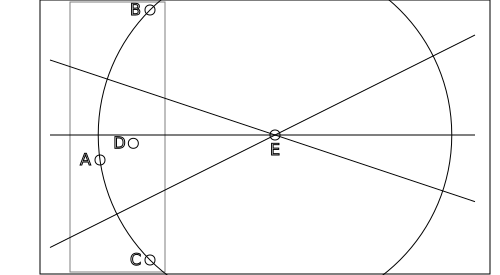
Figure 2: Eve locates the circumcenter of locations A, B, and C and proposes location E.
| Match Up | Vote Counts | Winner |
|---|---|---|
| A vs. E | 28 to 72 | E |
| B vs. E | 11 to 89 | E |
| C vs. E | 17 to 83 | E |
| D vs. E | 36 to 64 | E |
These results show that E is a new Condorcet winner, and the best option seen yet.
Challenging a Condorcet Winner ,,fold,,
Could the community do better? Frank is not sure, but suggests trying four more locations: F, G, H, and I. (See Figure 3.) These locations bracket E, and the clerk notices apparent support for F, G, and H along with a curious lack of support for I. The clerk proposes to take four more votes to compare these new locations to the current best location at E, and without objection, the votes are taken. The results for these comparisons are in Table 4. In these results we find something a little new. In both the third and fourth comparisons, two and eleven voters, respectively, did not express a preference between the locations.
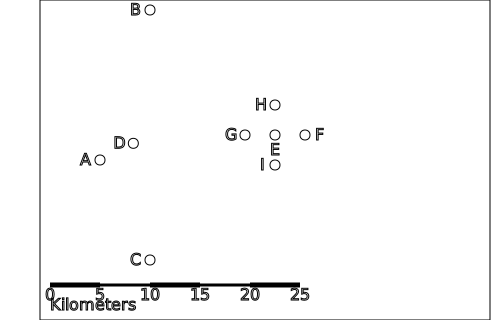
Figure 3: Frank proposes bracketing E with F, G, H, and I to see if there is more room for improvement.
| Match Up | Vote Counts | Winner |
|---|---|---|
| E vs. F | 61 to 39 | E |
| E vs. G | 55 to 45 | E |
| E vs. H | 71 to 27 (98 votes) | E |
| E vs. I | 59 to 30 (89 votes) | E |
The final Location ,,fold,,
The clerk announces this and asks if everyone thinks their individual ideal locations are within 25 km of E. (This distance is a reasonable bound for a strong cell phone signal based on the assumption that the signal degrades beyond 35 km and voters will mostly be within 10 km of their ideal location.) The general consensus of the community is that location E is good enough, and the community has collectively decided to use location E for their cell tower.
What Just Happened?
The cell tower example is carefully crafted story designed to show how a truly direct democracy can work in a relatively small group of people. The vote counts in this example may seem arbitrary, but they are all very clear and justified with full information. The entire example is built around images that map the exact preferences of every single voter. However, those images are not shown in the story because that data would be extremely unlikely to be available in real situations.
All the Voter Ideal Locations ,,fold,,
The full data is shown in Figure 4. Locations A, B, and C all have strong support from some voters—in particular Alice and the other four voters with ideals nearest A favor A, while Bob and the two other voters nearest B favor B,and Carol with her two neighbors favor C—but those voters are not representative of the whole community. One thing we can do With the full data, is generate the preference profile shown in Table 5. However, preference profiles are extremely limited in that much of the underlying data is discarded or never collected, so there is no information about story locations D through I because those locations have not yet been proposed.
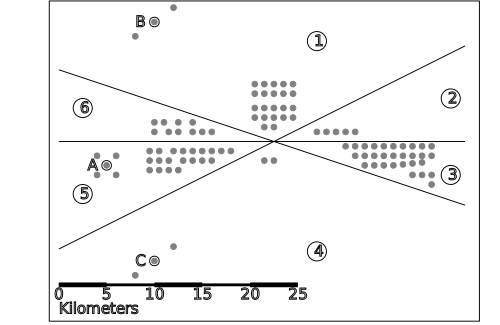
Figure 4: Full data, showing voter ideal locations, the three initial proposed locations, and indifference lines.
| Region | Preference order | voters |
|---|---|---|
| 1 | B \(\succ\) A \(\succ\) C | 25 |
| 2 | B \(\succ\) C \(\succ\) A | 5 |
| 3 | C \(\succ\) B \(\succ\) A | 30 |
| 4 | C \(\succ\) A \(\succ\) B | 5 |
| 5 | A \(\succ\) C \(\succ\) B | 25 |
| 6 | A \(\succ\) B \(\succ\) C | 5 |
Dave's Proposal to Break the Cycle ,,fold,,
In the story, Dave uses a fairly basic heuristic in proposing location D. The heuristic is when there is a majority cycle, a proposal that is in the middle of the cycle can often be preferred over all of the cycle members. So Dave simply used the centroid of triangle ABC for D. Figure 5 shows the construction of D and its indifference lines with A, B, and C.
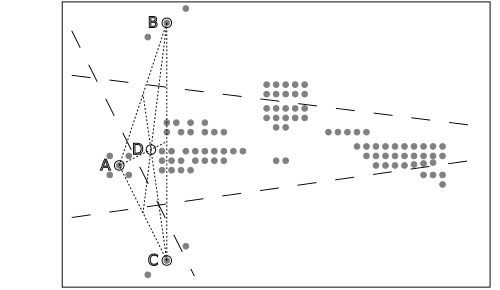
Figure 5: Construction of D as centroid of triangle ABC, along with D's indifference lines.
Eve's Proposal to Defeat a Condorcet Winner ,,fold,,
Eve used a similar heuristic when proposing location E. In her case, however, she used the circumcenter of triangle ABC instead of the centroid. Figure 6 shows the construction of E and its indifference lines with A, B, C and D.
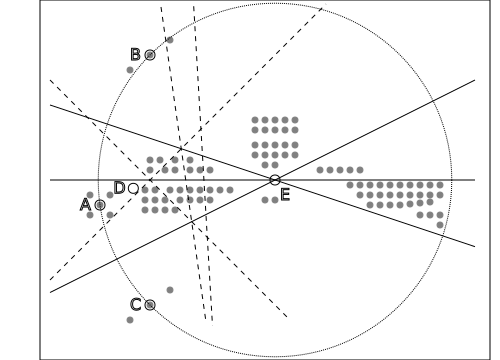
Figure 6: Construction of E as circumcenter of triangle ABC, along with E's indifference lines.
The Final Full Picture ,,fold,,
For completeness and ease of reference, Figure 7 shows all voters, all proposed locations (A through I), all indifference lines corresponding to the various votes, and five range circles with radius = 25km, centered on proposed cell tower locations A through E.
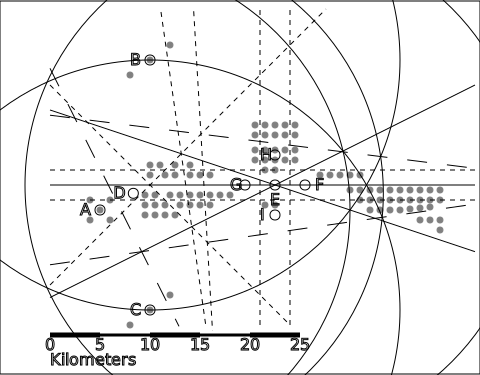
Figure 7: The full Cell Tower picture, with all voters, locations, and indifference lines corresponding to all votes.
What Does This All Mean?
If there is one thing we hope to get across from the cell tower story, it is that real democracy is possible. We do not need any special algorithms or complicated strategies to make democratic decisions in small groups. All it takes is a bit of iteration. Start with one of the initial alternatives as a focus and compare all the other alternatives one-by-one to the focus to see which of the proposed alternatives are better than the focus. Then pick an alternative better than the focus and repeat the process. At some point, one of two things will happen. Either the focus will be undefeated (a Condorcet winner), or the next focus is a non-consecutive repeat (part of a Condorcet cycle). When either of those events happens, ask for new alternatives. Eventually, the bounds on the focus will become clear to the voters and a vote to accept the current focus as the final winner will succeed. The group will then have a single winner that, although perhaps no one person's ideal, is deemed good enough for now.
We designed the cell tower story to emphasize a number of points. First, while the Condorcet paradox is real and Arrow's Impossibility Theorem is true, neither of these facts is necessarily an insurmountable barrier to getting a good outcome. This point is driven home by observing that both locations D and E are strictly better outcomes for the community as a whole than any of the initial three locations.
Second, both Condorcet cycles and Condorcet winners are properties of fixed sets of candidates. Removing a candidate can break a Condorcet cycle, and such an act can be accomplished in the example by either preventing Carol from introducing location E, or by staying with the single elimination tournament and preventing the detection of the cycle. Obviously, neither method improves the outcome. Adding a candidate can sometimes make a Condorcet cycle irrelevant by beating all its constituent candidates, such as Dave's introduction of location D. And just because a specific candidate is a Condorcet winner does not mean it is the best choice. A new candidate may be even better as shown when Eve introduced location E.
Third, a given slate of candidates may not include any acceptable options. A simple vote does not make this obvious. Location D is preferred by huge margins over all three of the initial locations, but if you consider the voters at the extreme east in Figure 7, there is not a lot of improvement in signal strength. This image shows 21 voter ideal positions on the east side that are more than 25 km from locations A, B, C and D, while all voters are comfortably within 25 km of location E. The votes from this region acknowledge that 30 km is closer than 34 km, but landslide agreement on one option being better than another option does not mean the better option is good enough. Similarly, one of a pair of options may be better than the other even when both are acceptable.
A fourth point is that a fixed time limit or candidate limit may stop the process before a good result is reached. This is implicitly supported by the story in that had Eve proposed a location other than E it could have taken longer to reach an acceptable outcome. Stopping before Frank introduced the last four locations bracketing E would have left open the possibility that another location might have been even better. (It is entirely possible to introduce a location that will beat E, but it would need to be fairly close to E, and thus would not provide dramatically different signal strength for most of the community.) The point here is that the process should not end before the voters explicitly decide it should end.
And a more general fifth point is that a truly direct democracy such as described in the example will need quite a bit of structure in order to scale to larger groups. The role of the clerk in the example is key to facilitating the process. In the context of the community meeting, the clerk arranges for the meeting time and place, receives the set of initial candidates, sets up all the votes, tallies the ballots, announces the results, receives the proposals for new candidates, and in general runs everything. Under some systems, such as a single elimination tournament or when there is power to block candidates from consideration, the clerk could have near dictatorial powers.
The end result of our thinking about iterative democracy and how to reliably implement it is described in What Is SAVE? and its sub-pages, and we believe SAVE can make large-scale democracy truly possible.