Arrow's Theorems

Serial Approval Vote Election (SAVE)
A new voting system for finding consensus
Arrow's Theorems and a Critique
In the 1950s, Kenneth J. Arrow first published his book, Social Choice and Welfare (Arrow [1951] 2012) in which he presented two theorems on social welfare functions. This work is noted for its axiomatic approach to social choice and in particular for his second theorem, now commonly known as Arrow's Impossibility theorem. Arrow's work on social welfare functions, and in particular his second theorem, is often given as the reason he shared the Nobel Memorial Prize in Economic Sciences with John Hicks in 1971. In this article I intend to present his axioms and both of his social welfare theorems, explain why the theorems are indeed true, and finish up by explaining some reasons why Arrow's work does not actually constrain a new class of social choice procedures.
Note 1: Arrow uses numbered equations, consequences, definitions, conditions, lemmas, and theorems. Definitions, conditions, lemmas, and theorems are numbered globally. Consequences and equations are numbered locally, starting from 1 in each new section. So there are equations numbered 1 following each of: Chapter V section 1 Definition 9, Chapter V section 2 Consequence 3, and Chapter V section 3 Consequence 1. And similarly multiple consequences numbered 1. Accordingly, in this reentering of the text from the online images, I am identifying Consequences by chapter.section.number, so in this page, "Consequence \(V.3.1\)" would in the original image text be seen as "Consequence \(1\)". Equations are identified by increasing numbers without restart. Most if not all equation references are within a paragraph or two of the actual equations, so this should not be a problem.
Note 2: The quoted text from Arrow ([1951] 2012) is actually from a Nook eBook of edition 3, with a cross reference from the Google Books version of edition 3. The Nook edition has occasionally garbled equations that seem so far to be correct in the Google Books edition. When in doubt, I have tried to correct the expressions to be consistent with the text arguments. All my changes are footnoted.
We start, as Arrow did, with some notation and basic definitions, and then go over each of his theorems. We then point out what are not exactly flaws in his work, but are rather limitations on the consequences of that work.
Definitions and Notations: Axioms I and II.
Arrow took care to be very precise in his definitions and notation, but the typographic limitations of publishing at the time restricted his notation to letters instead of the more recently available mathematical symbols.
In his study, Arrow assumes a basic set \(S\) of alternatives which could be presented to the chooser. These alternatives are mutually exclusive and denoted by small letters \(x, y, z\). Preference and indifference are relations between alternatives. However, Arrow chose to use a single relation, "preferred or indifferent", written as \(R\), to define both preference and indifference. Arrow's text notation for relations is summarized in Tab 1 along with more modern symbol notation.
| Text Description | Arrow Text | Symbolic Notation |
|---|---|---|
| \(x\) is preferred or indifferent to \(y\) | \(x R y\) | \(x\succsim{y}\) |
| \(x\) is preferred to \(y\) | \(x P y\) | \(x\succ{y}\) |
| \(x\) is indifferent to \(y\) | \(x I y\) | \(x\sim{y}\) |
Arrow stated two axioms that he refers to later regarding the relations he considers. His relations are to be complete, and they are to be transitive.1
Axiom I: For all \(x,y\) in \(S\),2 either \(x R y\) or \(y R x\).
In modern mathematical notation Arrow's \(R\) is replaced by the symbol \(\succsim\), and the preceding statement is written: \(\forall x,y\in{S}, x\succsim{y}\lor{y}\succsim{x}\).
Axiom II: For all \(x,y,z\in{S}\),3 \(x R y\) and \(y R z\) imply \(x R z\).
Symbolically, this is stated: \(\forall x,y,z\in{S}, x\succsim{y}\land{y}\succsim{z}\Rightarrow{x}\succsim{z}\).
A relation that is both complete and transitive is termed a weak ordering, or sometimes simply an ordering, which can also be called a ranking. The weak part refers to the possibility of ties. A strong ordering is one in which ties are not allowed.
Arrow defines the relations for preference \(P\) and indifference \(I\) in terms of \(R\).
Definition 1: \(x P y\) means not \(y R x\).
Or using symbols: \(x\succ{y}\equiv\neg{y}\succsim{x}\).
Definition 2: \(x I y\) means \(x R y\) and \(y R x\).
Or using symbols: \(x\sim{y}\equiv{x}\succsim{y}\land{y}\succsim{x}\).
Lemma 1:
Arrow's text Symbolic notation (a) For all x, \(x R x\). \(\forall x: x\succsim{x}\) (b) If \(x P y\), then \(x R y\). \(x\succ{y}\Rightarrow x\succsim{y}\) (c) If \(x P y\) and \(y P z\), then \(x P z\). \(x\succ{y}\land{y}\succ{z}\Rightarrow{x}\succ{z}\) (d) If \(x I y\) and \(y I z\), then \(x I z\). \(x\sim{y}\land{y}\sim{z}\Rightarrow{x}\sim{z}\) (e) For all \(x\) and \(y\), either \(x R y\) or \(y P x\), \(\forall x,y: x\succsim{y}\lor{y}\succ{x}\) (f) If \(x P y\) and \(y R z\), then \(x P z\). \(x\succ{y}\land{y}\succsim{z}\Rightarrow{x}\succ{z}\)
Arrow then proves his definitions of \(P\) and \(I\) match the expected definitions of strict preference and indifference.
Additionally, Arrow presents a definition choice in terms of a weak ordering relation and a choice function.
Definition 3: \(C(S)\) is the set of all alternatives \(x\) in \(S\) such that, for every \(y\) in \(S\), \(x R y\).
Or symbolically: \(C(S)=\lbrace{x}\in{S}| \left(\forall{y}\in{S}\right)\left[x\succsim{y}\right]\rbrace\)
Lemma 2: A necessary and sufficient condition that \(x P y\) is that \(x\) be the sole element of \(C([x,y])\).
Or symbolically: given \(x,y\in{S}\), \(x\succ{y} \Leftrightarrow C(\{x,y\})=\{x\}\).
Social Welfare Functions
Arrow addresses the problem of social choice, and states it in terms of a social welfare function as follows:
Definition 4: By a social welfare function will be meant a process or rule which, for each set of individual orderings \(R_{1},\dotsc,R_{n}\) for alternative social states (one ordering for each individual), states a corresponding social ordering of alternative social states, \(R\).4
(Notationally, when a relation is sub-scripted, such as \(R_{i}\) (or \(\succsim_{i}\)), the relation is that of an individual. When a relation is not sub-scripted, such as \(P\) (or \(\succ\)), it is either an abstract relation in general, or the collective social ordering of alternatives states derived from the set of individual orderings. This distinction is usually clear from context.)
Arrow was generally interested in the problem of social choice from a mathematical perspective. He considered the task of starting with a collection of individual preference orders of a set of alternatives and using those alternatives to derive a social preference order.
He also makes a distinction between a universal social welfare function, which would take as input any set of ordering relations, and a social welfare function restricted to a domain of admissible ordering relations.
Condition 1: Among all the alternatives there is a set \(S\) of three alternatives such that, for any set of individual orderings \(T_{1},\dotsc,T_{n}\) of the alternatives in \(S\), there is an admissible set of individual orderings \(R_{1},\dotsc,R_{n}\) of all the alternatives such that, for each individual \(i\), \(x R_{i} y\) if and only if \(x T_{i} y\) for \(x\) and \(y\) in \(S\).
I found the above condition confusing at first, so I restate it here for clarity. For notation, let \(N\) be the number of individuals, \(U,S\) be sets of alternatives, \(\mathbb{U,S}\) be the sets of all possible lists of length \(N\) of orderings of \(U\) and \(S\) respectively, and \(\mathbb{U}_{a}\) and \(\mathbb{S}_{a}\) be the collection of all lists of orderings of \(U\) and \(S\) respectively that are admissible for the social welfare function. Condition 1 states there must exist some \(S\subset{U}\) such that \(|S|=3\) and \(\mathbb{S}_{a}=\mathbb{S}\). And further that for each \(T_{1},\dotsc,T_{N}\) in \(\mathbb{S}\) there is at least one \(R_{1},\dotsc,R_{N}\) in \(\mathbb{U}_{a}\) such that for all ordered pairs \((x,y)\in{S}\times{S}\) (of which there are 9), and for all \(N\) individuals \(i\), \(x R_{i} y \Leftrightarrow x T_{i} y\).
This condition requires the social welfare function return a true social ordering for some sufficiently wide range of sets of individual orderings.
In particular, Arrow's Condition 1 explicitly requires that all of the voter ideal location positions shown in Fig 1 would have to yield admissible orderings.
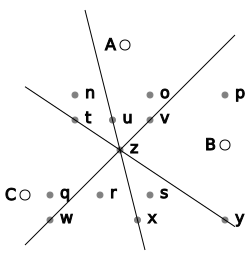
Figure 1: An example of the orderings required by Condition 1. \(A,B,C\) are alternatives, \(n,o,p,q,r,s\) are pure preferences, \(t,u,v,w,x,y\) are orderings with indifference between one pair of alternatives, and \(z\) is indifferent to all three alternatives. In this spatial illustration voter orderings are in terms of the normal Euclidean metric, with closer alternatives ranked higher than those further away.
All the orderings by voter are listed in Tab 2.
| voter | strict orderings | voter | orderings with indifference |
|---|---|---|---|
| n | \(A\succ{C}\succ{B}\) | t | \(A \sim C \succ B\) |
| o | \(A\succ{B}\succ{C}\) | u | \(A \succ B \sim C\) |
| p | \(B\succ{A}\succ{C}\) | v | \(A \sim B \succ C\) |
| q | \(C\succ{A}\succ{B}\) | w | \(C \succ A \sim B\) |
| r | \(C\succ{B}\succ{A}\) | x | \(B \sim C \succ A\) |
| s | \(B\succ{C}\succ{A}\) | y | \(B \succ A \sim C\) |
| z | \(A \sim B \sim C\) |
The issue here is that Arrow's Condition 1 is in direct conflict with Arrow's desire for a social welfare function to return a complete and transitive order. I agree with his Condition 1. I disagree strongly with the idea that collective preferences need to be transitive, or even complete. But more on that later.
Other apparently reasonable conditions on the social welfare function follow.
Positive Association of Social and Individual Values
The condition of positive association of social and individual values (often abbreviated PA) simply means if the only difference between two orderings is support for alternative \(x\) has increased in the second input compared to the first, the social welfare function should not rank \(x\) lower in the second output than it did in the first. That is, increased support should only ever help an alternatives and should never hurt it.
Condition 2: Let \(R_{1},\dotsc,R_{n}\) and \(R_{1}^{\prime},\dotsc,R_{n}^{\prime}\) be two sets of individual ordering relations, \(R\) and \(R^{\prime}\) the corresponding social orderings, and \(P\) and \(P^{\prime}\) the corresponding social preference relations. Suppose that for each \(i\) the two individual ordering relations are connected in the following [three] ways: for \(x^{\prime}\) and \(y^{\prime}\) distinct from \(x\), [a] \(x^{\prime}R_{i}^{\prime}y^{\prime}\) if and only if \(x^{\prime}R_{i}y^{\prime}\), [b] for all \(y^{\prime}\), \(x R_{i}^{\prime} y^{\prime}\) implies \(x R_{i} y^{\prime}\), and [c] for all \(y^{\prime}\), \(x P_{i} y^{\prime}\) implies \(x P_{i}^{\prime} y^{\prime}\). Then, if \(x P y\), \(x P^{\prime} y\).
Independence of Irrelevant Alternatives
The condition of independence of irrelevant alternatives (often abbreviated IIA) basically means the choice function should not change the preference order between two alternatives depending on the presence or absence of a third alternative.
Condition 3: Let \(R_{1},\dotsc,R_{n}\) and \(R_{1}^{\prime},\dotsc,R_{n}^{\prime}\)5 to be two sets of individual orderings and let \(C(S)\) and \(C^{\prime}(S)\) be the corresponding social choice functions. If, for all individuals \(i\) and all \(x\) and \(y\) in a given environment \(S\), \(xR_{i}y\) if and only if \(xR_{i}^{\prime}y\), then \(C(S)\) and \(C^{\prime}(S)\) are the same (independence of irrelevant alternatives).
In the text, Arrow states the problem IIA is meant to avoid is presented in terms of the Borda count with \(3\) voters and \(4\) alternatives \(x,y,z,w\). Voters \(1\) and \(2\) have preference orders \(x\succ{y}\succ{z}\succ{w}\), while voter 2 has \(z\succ{w}\succ{x}\succ{y}\). With those preferences, \(x\) is chosen. But if for some reason after the ballots have been cast, \(y\) is eliminated (such as in the death of a candidate), the ballots are treated as if they had been: \(x\succ{z}\succ{w}\) for voters \(1\) and \(2\), and \(z\succ{w}\succ{x}\) for voter \(3\). The revised Borda count now results in a tie between \(x\) and \(z\). Thus, and this is not explicit in Arrow's text, \(S \subset A\), where \(A\) is the set of alternatives ranked in \(R_{i}\) and \(R_{i}^{\prime}\).
This condition is a bit difficult to explain, but one story that might help is this. Alice and Bob are picking up a pie for a picnic. Bob asks Alice what type of pies are available. Alice replies apple pie and blueberry pie. Bob says, okay we'll get apple pie. Alice then sees cherry pie is also available and tells Bob his extra alternative. Bob then replies, "okay, then we'll get the blueberry pie".
This is a violation of the independence of irrelevant alternatives. Bob's original response indicated a preference for apple pie over blueberry pie. The addition of cherry pie to the set of alternatives should not have caused Bob's preference of apple pie over blueberry pie to change. When Bob was informed of the additional alternative of Cherry pie after having stated his preference for Apple pie over Blueberry pie, IIA limits Bob's legitimate choices to be either: (1) re-confirming his preference for Apple pie, or (2) changing his selection to the new alternative of Cherry pie.
Citizens' Sovereignty
The condition of citizens' sovereignty (CA) is simply that in a democracy, the outcome is based on the citizens' choice and not imposed by the social welfare function. A clear statement of this condition requires a definition of "imposed":
Definition 5: A social welfare function will be said to be imposed if, for some pair of distinct alternatives \(x\) and \(y\), \(x R y\) for any set of individual orderings \(R_{1},\dotsc,R_{n}\), where \(R\) is the social ordering corresponding to \(R_{1},\dotsc,R_{n}\).
While Arrow points out that Definition 5 may not be ideal from the standpoint of individual desires that may violate group norms, his main concern for the purposes of this argument is disallowing external control, such as would be the case in a colony or an occupied country.
Condition 4: The social welfare function is not to be imposed.
Arrow also notes CA excludes the Platonic case of an ideal realm governed by ultimate philosophical truths. The Platonic ideal of a society ruled by philosopher kings is not a democracy.
Nondictatorship
The condition of nondictatorship (ND) is another desirable characteristic of a democracy. As with CA, Arrow starts with a careful definition of dictatorial, and follows it with the condition that a social welfare function should not be so.
Definition 6: A social welfare function is said to be dictatorial if there exists an individual \(i\) such that, for all \(x\) and \(y\), \(x P_{i} y\) implies \(x P y\) regardless of the orderings \(R_{1},\dotsc,R_{n}\) of all individuals other than \(i\), where \(P\) is the social preference relation corresponding to \(R_{1},\dotsc,R_{n}\).6
Condition 5: The social welfare function is not to be dictatorial (non-dictatorship).
Arrow is careful to state that this definition is not a true model of actual dictatorship. He also then states that this is a reasonable condition to impose on the form of a social welfare function.
Arrow ends the chapter with a section on the summation of utilities a social welfare function (including two definitions on quasi-ordering which do not concern us here), saying in essence that it is unworkable, and then proceeds with a chapter on compensation before he finally gets to the chapter with his two theorems on social welfare functions.
The Payment of Compensation
This section from Arrow's Chapter IV: The Compensation Principle contains two definitions which are of interest (to me anyway) mostly because Definition 8 concerns quasi-orderings and is used in the statement of Arrow's Theorem 2.
Let us now define a relation, \(x Q y\), as follows:
\begin{align} \label{orga83d1c4} x Q y\ \mathit{means\ that,\ for\ all}\ i,\ x R_{i} y. \end{align}It has been assumed that, for all \(i\), \(R_{i}\) is a weak ordering relation and so satisfies Axioms I and II. From Lemma 1(a),
\begin{align} \label{org88b207e} \mathit{for\ all}\ i,\ x R_{i} x. \end{align}From Axiom II,
\begin{align} \label{org60f4188} \mathit{for\,all}\,i,\,x R_{i} y\,\mathit{and}\,y R_{i} z\,\mathit{imply}\,x R_{i} z. \end{align}From \eqref{org88b207e} and \eqref{orga83d1c4}, it is clear that,
\begin{align} \label{orgdebf141} \mathit{for\ all}\ x,\ x Q x. \end{align}Suppose that we have \(x Q y\) and \(y Q z\); then, for each \(i\), \(x R_{i} y\) and \(y R_{i} z\), by \eqref{orga83d1c4}, so that, for each \(i\), \(x R_{i} z\), by \eqref{org60f4188}. But then, by \eqref{orga83d1c4}, \(x Q z\). Therefore,
\begin{align} \label{org75d2b87} \mathit{for\,all}\,x,\,y,\!\mathit{and}\ z,\,x Q y\,\mathit{and}\ y Q z\,\mathit{imply}\ x Q z. \end{align}For convenience, we will introduce a formal definition for relations having properties \eqref{orgdebf141} and \eqref{org75d2b87}.
Definition 7: \(Q\) is said to be a quasi-ordering if,
- for all \(x\), \(x Q x\);
- for all \(x\), \(y\), and \(z\), \(x Q y\) and \(y Q z\) imply \(x Q z\).
Note that under this definition some pairs of alternatives can be compared under a given quasi-ordering while there may be other pairs that are not comparable, i.e., such that neither \(x Q y\) nor \(y Q x\).
We are saying, then, that the particular relation \(Q\) defined by \eqref{orga83d1c4} is a quasi-ordering of the space of alternatives. Suppose that, in the case of our particular \(Q\), we know that the individual orderings \(R_{1},\dotsc,R_{n}\) are such that \(x Q y\). Then we certainly feel that we could assert that \(x R y\), though we would not be able to assert that \(x P y\), since, for example, we can have \(x Q y\) because \(x I_{i} y\) for each \(i\).
Suppose, in the case of the relation \(Q\) defined by \eqref{orga83d1c4}, we know that the individual orderings are such that \(x Q y\) and not \(y Q x\). From \eqref{orga83d1c4}, this means that for all \(i\), \(x R_{i} y\), while, for at least one \(i\), not \(y R_{i} x\), which, by Lemma 1(e), means that, for at least one \(i\), \(x P_{i} y\). This is the assumption of the form of the compensation principle with which we started. We would feel it reasonable to require that, under these circumstances, \(x P y\). Summing up, the relations between \(Q\) and the social ordering \(R\) are that \(x Q y\) implies \(x R y\), and that \(x Q y\) and not \(y Q x\) imply \(x R y\) and not \(y R x\). We shall introduce this as a general definition.
Definition 8: \(R\) is said to be compatible with \(Q\) if
- \(R\) is a weak ordering;
- \(Q\) is a quasi-ordering;
- for all \(x\) and \(y\), \(x Q y\) implies \(x R y\);
- for all \(x\) and \(y\), \(x Q y\) and not \(y Q x\) imply not \(y R x\).
Arrow uses quasi-orderings to discuss the idea of compensation.
For our purposes, the only thing that concerns us is that if a set of alternatives in a quasi-ordering are comparable, the comparisons are transitive.
Arrow's Two Theorems on Social Welfare Functions
As mentioned previously, Arrow has two theorems on social welfare functions. They differ only in the number of alternatives available, but that difference is very significant. When there are only two alternatives, there is a social welfare function that satisfies Arrow's criteria. But in the general case, when there are more than two alternatives, there is no possibility of satisfying the same criteria.
Arrow's Theorem 1: Possibility Theorem for Two Alternatives
In order to consider a social welfare function over only two alternatives it is necessary to modify Condition 1. As stated earlier, Condition 1 requires three distinct alternatives, and that is obviously not going to be the case when there are only two alternatives. Instead of Condition 1, Arrow requires, "every set of individual orderings of the two alternatives in question give rise to a social ordering satisfying Axioms I and II."
This next section is an extended quote of the remainder of Arrow ([1951] 2012, vol. 12, chap. V section 1).
Definition 9: By the method of majority decision is meant the social welfare function in which \(x R y\) holds if and only if the number of individuals such that \(x R_{i} y\) is at least as great as the number of individuals such that \(y R_{i} x\).
It is not hard to see that the method of majority decision satisfies Conditions 2-5 when there are only two alternatives. To show that it satisfies Condition 1 we must show that \(R\), as defined, is a weak ordering, i.e., is connected and transitive. For convenience, let \(N(x,y)\) be the number of individuals such that \(x R_{i} y\). Then:
\begin{align} \label{orgecade9c} x R y \mathit{\ if\ and\ only\ if}\ N(x,y)\ge{N}(y,x). \end{align}Clearly, always either \(N(x,y)\ge{N}(y,x)\) or \(N(y,x)\ge{N}(x,y)\), so that,
\begin{align} \label{org326aeac} \mathit{for\ all\ x\ and\ y,}\ x R y\ \mathit{or}\ y R x, \end{align}by \eqref{orgecade9c}, and \(R\) is connected. To show transitivity, suppose \(x R y\) and \(y R z\). Since there are only two alternatives, two of \(x\), \(y\), and \(z\) are equal. As already shown in the case of the Scitovsky compensation principle7, the conclusion \(x R z\) is trivial if \(x=y\) or \(y=z\). To show \(x R z\) in the case \(x=z\) is equivalent to showing \(x R x\). But, by \eqref{orgecade9c}, \(x R x\) is equivalent to the proposition \(N(x,x)\ge{N}(x,x)\), and is certainly true. Hence, transitivity holds. In conjunction with \eqref{org326aeac}, this proves \(R\) is a weak ordering, so that
\begin{align} \label{org384dc02} \mathit{the\,method\,of\,majority\,decision\,satisfies\,Condition\,1.} \end{align}Now consider Condition 2. Let \(R_{1},\dotsc,R_{n}\) be such that \(x P y\), i.e. \(x R y\) and not \(y R x\). By \eqref{orgecade9c}, this means \(N(x,y)\ge{N}(y,x)\) but not \(N(y,x)\ge{}N(x,y)\) i.e.,
\begin{align} \label{org7c0a15f} N(x,y)\ge{}N(y,x) \end{align}Let \(R_{i}^{\prime},\dotsc,R_{n}^{\prime}\)8 be a new set of individual orderings satisfying the hypothesis of Condition 2, i.e., for \(x^{\prime}\ne{x}\), \(y^{\prime}\ne{x}\), [a] \(x^{\prime} R_{i}^{\prime} y^{\prime}\) if and only if \(x^{\prime} R_{i} y^{\prime}\); [b] \(x R_{i} y^{\prime}\) implies \(x R_{i}^{\prime} y^{\prime}\); and [c] \(x P_{i} y^{\prime}\) implies \(x P_{i}^{\prime} y^{\prime}\). Consider, in particular, the last two conditions with \(y^{\prime}=y\).
\begin{align} \label{org927ada5} x R_{i} y\ \mathit{implies}\ x R_{i}^{\prime} y; \end{align} \begin{align} \label{orgd4f02b4} x P_{i} y\ \mathit{implies}\ x P_{i}^{\prime} y. \end{align}Suppose, for some \(i\), \(y R_{i}^{\prime} x\). By Definition 1, not \(x P_{i}^{\prime} y\), and therefore, by \eqref{orgd4f02b4}, not \(x P_{i} y\). Hence, by Lemma 1(e)9, \(y R_{i} x\). That is,
\begin{align} \label{orga87c13c} y R_{i}^{\prime} x\ \mathit{implies}\ y R_{i} x; \end{align}Let \(N^{\prime}(x,y)\) be the number of individuals for whom \(x R_{i}^{\prime} y\); similarly, \(N^{\prime}(y,x)\) is the number of individuals for whom \(y R_{i}^{\prime} x\). By \eqref{org927ada5}, every individual for whom \(x R_{i} y\) has the property \(x R_{i}^{\prime} y\);10 hence,\(N^{\prime}(x,y)\gt{N}(x,y)\). Similarly, from \eqref{orga87c13c}, \(N(y,x)\ge{N}^{\prime}(y,x)\). From \eqref{org7c0a15f}, \(N^{\prime}(x,y)\ge{N}^{\prime}(y,x)\) or \(N^{\prime}(x,y)\ge{N}^{\prime}(y,x)\) and not \(N^{\prime}(y,x)\ge{N}^{\prime}(x,y)\). By \eqref{orgecade9c}, this means that \(x R^{\prime} y\) but not \(y R^{\prime} x\),11 where \(R^{\prime}\) is the social ordering corresponding to the set of individual orderings \(R_{1}^{\prime},\dotsc,R_{n}^{\prime}\), or \(x P^{\prime} y\), by Definition 1. Therefore, Condition 2 is satisfied.
Condition 3 (independence of irrelevant alternatives) is trivial in this case because the only set \(S\) that contains more than one member contains the entire universe, which consists of two members. If \(S\) contains one element, \(C(S)\) is that one element independent of tastes about alternatives not in \(S\); if \(S\) contains two elements, \(C(S)\) is certainly determined by individual orderings for elements in \(S\) since there are no others.
As for Condition 4 for any \(x\) and \(y\), suppose that individual orderings were such that \(y P_{i} x\) for all \(i\). Then, for everybody, \(y R_{i} x\), while, for nobody, \(x R_{i} y\). Hence, \(N(y,x)\ge{N}(x,y)\) but not \(N(x,y)\ge{N}(y,x)\), so, by \eqref{orgecade9c}, \(y P x\), and therefore not \(x R y\), by Definition 1. Hence, we do not have \(x R y\) independent of the individual orderings \(R_{1},\dotsc,R_{n}\).
Finally, as for Condition 5 (nondictatorship), suppose that there were an individual \(i\) satisfying the conditions of Definition 6. Call him \(1\). Suppose \(x P_{1} y\), while \(y P_{i} x\) for all \(i \ne 1\).12 Then, \(x R_{1} y\), not \(x R_{i}^{\prime} y\) for \(i\ne{1}\), by Definition 1, so that \(N(x,y)=1\). Also, \(y R_{i} x\) for \(1\), so that \(N(y,x)\ge{1}=N(x,y)\). By \eqref{orgecade9c}, \(y R x\), and therefore, by Definition 1, not \(x P y\). By Definition 6, however, \(x P_{1} y\) implies \(x P y\). Hence, there cannot be any dictator, so that Condition 5 is satisfied.
Theorem 1 (Possibility Theorem for Two Alternatives): If the total number of alternatives is two, the method of majority decision is a social welfare function which satisfies Conditions 2-5 and yields a social ordering of the two alternatives for every set of individual orderings.
Theorem 1 is, in a sense the logical foundation of the Anglo-American two-party system.
For later reference, observe that the proof given above that the method of majority decision satisfies Conditions 2, 4, and 5 was independent of the assumption that there were only two alternatives. It is also true that the method of majority decision satisfies Condition 3 regardless of the total number of alternatives. From Definition 9, it is obvious that the truth or falsity of the statement \(x R y\) is invariant under any change of individual orderings which leaves invariant, for each individual, the relative position of \(x\) and \(y\). By Definition 3, \(C(S)\) is completely determined by knowing the truth or falsity of the statement \(x R y\) for every pair \(x,y\) of elements in \(S\); hence, \(C(S)\) is certainly invariant under any change of the individual orderings which leaves the orderings within \(S\) invariant.
Lemma 3: For any space of alternatives, the method of majority decision is a social welfare function satisfying Conditions 2-5.
The example of the paradox of voting given in Chapter I, Section 1, shows that the method of majority decision does not satisfy Condition 1 when there are more than two alternatives. We are now prepared to examine the construction of social welfare functions in this last case.
We shall hereafter assume that Condition 1 holds in its original form.
The method of majority decision is a satisfactory social welfare function when there are only two alternatives. Moreover, May (1952) shows that any social welfare function satisfying Arrow's condition for two alternatives is equivalent to Arrow's definition of the method of majority decision.
Two Individuals and Three Alternatives
On the way to his general possibility theorem, Arrow looks at the special case of two individuals and three alternatives. Chapter IV, section 2 is also quoted from his book:
To illustrate the methods of analysis and serve as an introduction to the more general case, we shall consider first the formation of a social welfare function for two individuals expressing their preferences for three alternatives. Some consequences will be drawn from Conditions 1-5. It will be shown that the supposition that there is a social welfare function satisfying those conditions leads to a contradiction.
Let \(x,y,z\) be three alternatives among which choice is to be made, e.g., three possible distributions of commodities. Let \(x^{\prime}\) and \(y^{\prime}\) be variable symbols which represent possible alternatives, i.e., which range over the values \(x, y, z\). Let the individuals be designated as \(1\) and \(2\), and let \(R_{1}\) and \(R_{2}\) be the orderings by \(1\) and \(2\), respectively, of the alternatives \(x, y, z\). Let \(P_{1}\) and \(P_{2}\) be the corresponding preference relations; e.g., \(x^{\prime} P_{1} y^{\prime}\) means that individual \(1\) strictly prefers \(x^{\prime}\) to \(y^{\prime}\). It is assumed that there is no a priori reason to suppose that the individuals will not order the alternatives in any given way. For example, if it is supposed that each individual values each distribution of commodities in accordance with his preference for his personal share alone (individualistic behavior), if there is more than one commodity, and if no alternative gives any individual more of all commodities than any other alternative, then, by suitable variation of tastes, each individual may order the alternatives in any logically possible manner (see Chapter VI, Section 4, for an example).
Consequence V.2.1: if \(x^{\prime} P_{1} y^{\prime}\) and \(x^{\prime} P_{2} y^{\prime}\) then \(x^{\prime} P y^{\prime}\).
That is, if both prefer \(x^{\prime}\) to \(y^{\prime}\), then the society must prefer \(x^{\prime}\) to \(y^{\prime}\).
Proof: By Condition 4, there are orderings \(R_{1}^{\prime}\) and \(R_{2}^{\prime}\) for individuals \(1\) and \(2\), respectively, such that, in the corresponding social preference, \(x^{\prime} P^{\prime} y^{\prime}\). Form \(R_{1}^{\prime\prime}\) from \(R_{1}^{\prime}\) by raising \(x^{\prime}\), if need be, to the top while leaving the other two alternatives alone. Form \(R_{2}^{\prime\prime}\) from \(R_{2}^{\prime}\) in the same way.13 Since all we have done is raise alternative \(x^{\prime}\) in everyone's esteem while leaving the others alone, \(x^{\prime}\) should still be preferred to \(y^{\prime}\) by society in accordance with Condition 2, so that \(x^{\prime} P^{\prime\prime} y^{\prime}\). But, by construction, both individuals prefer \(x^{\prime}\) to \(y^{\prime}\), and society prefers \(x^{\prime}\) to \(y^{\prime}\). Since, by Condition 3, the social choice between \(x^{\prime}\) ando \(y^{\prime}\) depends only on the individual orderings of those two alternatives, it follows that whenever both individuals prefer \(x^{\prime}\) to \(y^{\prime}\), regardless of the rank of the third alternative, society will prefer \(x^{\prime}\) to \(y^{\prime}\), which is the statement to be proved.
Consequence V.2.2: Suppose that for some \(x^{\prime}\) and \(y^{\prime}\), whenever \(x^{\prime} P_{1} y^{\prime}\) and \(y^{\prime} P_{2} x^{\prime}\), \(x^{\prime} P y^{\prime}\).14 Then, whenever \(x^{\prime} P_{1} y^{\prime}\), \(x^{\prime} P y^{\prime}\).
That is, if in a given choice the will of individual \(1\) prevails against the opposition of \(2\), then individual \(1\)'s views will certainly prevail if \(2\) is indifferent or if he agrees with \(1\).
Proof: Let \(R_{1}\) be an ordering in which \(x^{\prime} P_{1} y^{\prime}\), and let \(R_{2}\) be any ordering. Let \(R_{1}^{\prime}\) be the same ordering as \(R_{1}\), while \(R_{2}^{\prime}\) is derived from \(R_{2}\) by depressing \(x^{\prime}\) to the bottom while leaving the relative positions of the other two alternatives unchanged. By construction, \(x^{\prime} P_{1}^{\prime} y^{\prime}\), \(y^{\prime} P_{2}^{\prime} x^{\prime}\). By hypothesis, \(x^{\prime} P^{\prime} y^{\prime}\), where \(P^{\prime}\) is the social preference relation derived from the individual orderings \(R_{1}^{\prime},R_{2}^{\prime}\).15 Now the only difference between \(R_{1}^{\prime},R_{2}^{\prime}\) and \(R_{1},R_{2}\) is that \(x^{\prime}\) is16 raised in the scale of individual \(2\) in the latter as compared with the former. Hence, by Condition 2, (interchanging the \(R_{i}\)'s and the \(R_{i}^{\prime}\)'s), it follows from \(x^{\prime} P^{\prime} y^{\prime}\) that \(x^{\prime} P y^{\prime}\). That is, whenever \(R_{1},R_{2}\) are such that \(x^{\prime} P_{1} y^{\prime}\) then \(x^{\prime} P y^{\prime}\).
Consequence V.2.3: If \(x^{\prime} P_{1} y^{\prime}\) and \(y^{\prime} P_{2} x^{\prime}\), then \(x^{\prime} I y^{\prime}\).
That is, if the two individuals have exactly opposing interests in the choice between two given alternatives, then society will be indifferent between the alternatives.
Proof: Suppose the consequence is false. Then, for some orderings \(R_{1}\) and \(R_{2}\) and17 and for some pair of alternatives \(x^{\prime}\) and \(y^{\prime}\) we would have \(x^{\prime} P_{1} y^{\prime}\), \(y^{\prime} P_{2} x^{\prime}\), but not \(x^{\prime} I y^{\prime}\). In that case, either \(x^{\prime} P y^{\prime}\) or \(y^{\prime} P x^{\prime}\). We will suppose \(x^{\prime} P y^{\prime}\) and show that this supposition leads to a contradiction; the same reasoning would show that the assumption \(y^{\prime} P x^{\prime}\) also leads to a contradiction.
Without loss of generality, it can be assumed that \(x^{\prime}\) is the alternative \(x\) and \(y^{\prime} = y\).18 Then we have, for the particular orderings in question, \(x P_{1} y\), \(y P_{2} x\) and \(x P y\). Since the social choice between \(x\) and \(y\) depends, by Condition 3, only on the individual choices between \(x\) and \(y\), we must have
\begin{align} \label{org92d93e1} \mathit{whenever}\ x P_{1} y\ \mathit{and}\ y P_{2} x,\ x P y. \end{align}It will be shown that \eqref{org92d93e1} leads to a contradiction.
Suppose than individual \(1\) prefers \(x\) to \(y\) and \(y\) to \(z\), while individual \(2\) prefers \(y\) to \(z\) and \(z\) to \(x\). By \eqref{org92d93e1}, society prefers \(x\) to \(y\). Also, both prefer \(y\) to \(z\); by Consequence V.2.1, society prefers \(y\) to \(z\). Since society prefers \(x\) to \(y\) and \(y\) to \(z\), it must prefer \(x\) to \(z\). Therefore we have exhibited orderings \(R_{1},R_{2}\) such that \(x P_{1} z\), \(z P_{2} x\), but \(x P z\). Since the social choices between \(x\) and \(z\) depends only on the individual preferences for \(x\) and \(z\),
\begin{align} \label{org7e3ccd2} \mathit{whenever}\ x P_{1} z\ \mathit{and}\ z P_{2} x,\ x P z. \end{align}Now suppose that \(R_{1}\) is the ordering \(y,x,z\) and \(R_{2}\) is the ordering \(z,y,x\). By Consequence V.2.1, \(y P x\); by \eqref{org7e3ccd2}, \(x P z\), so that \(y P z\). By the same reasoning as before,
\begin{align} \label{orgd472f38} \mathit{whenever}\ y P_{1} z\ \mathit{and}\ z P_{2} x,\ y P z. \end{align}If \(R_{1}\) is the ordering \(y,z,x\), and \(R_{2}\) is the ordering \(z,x,y\), it follows from Consequence V.2.1 and \eqref{orgd472f38} that \(z P x\) and \(y P z\), so that \(y P x\). Hence,
\begin{align} \label{orgba9120d} \mathit{whenever}\ y P_{1} x\ \mathit{and}\ x P_{2} y,\ y P x. \end{align}If \(R_{1}\) is the ordering \(z,y,x\), and \(R_{2}\) is the ordering \(x,z,y\), then from Consequence V.2.1 and \eqref{orgba9120d} that \(z P y\) and \(y P x\), so that \(z P x\).
\begin{align} \label{org2dd4a8a} \mathit{Whenever}\ z P_{1} x\ \mathit{and}\ x P_{2} z,\ z P x. \end{align}If \(R_{1}\) is the ordering \(z,x,y\), and \(R_{2}\) is the ordering \(x,y,z\), then using \eqref{org2dd4a8a}, \(z P x\) and \(x P y\), so that \(z P y\).
\begin{align} \label{org87e6e98} \mathit{Whenever}\ z P_{1} y\ \mathit{and}\ y P_{2} z,\ z P y. \end{align}From \eqref{org92d93e1} it follows from Consequence V.2.2 that, whenever \(x P_{1} y\), \(x P y\). Similarly, from \eqref{org92d93e1}-\eqref{org87e6e98}, it follows that for any pair of alternatives \(x^{\prime},y^{\prime}\), whenever \(x^{\prime} P_{1} y^{\prime}\), then \(x^{\prime} P y^{\prime}\). That is, by Definition 6, individual \(1\) would be a dictator. This is prohibited by Condition 5, so that \eqref{org92d93e1} must be false. Therefore Consequence V.2.3 is proved.
Now suppose that individual \(1\) has the ordering \(x,y,z\), while individual \(2\) has the ordering \(z,x,y\). By Consequence V.2.1,
\begin{align} \label{org425b0d0} x P y. \end{align}Since \(y P_{1} z\), \(z P_{2} y\), it follows from Consequence V.2.3 that
\begin{align} \label{org4124c9b} y I z. \end{align}From \eqref{org425b0d0} and \eqref{org4124c9b}, \(x P z\). but also \(x P_{1} z\), \(z P_{2} x\),19 which implies \(x I y\) by Consequence V.2.3. It cannot be that \(x\) is both preferred and indifferent to \(z\). Hence the assumption that there is a social welfare function compatible with Conditions 1-5 has led to a contradiction.
Next, Arrow provides a proof of his general possibility theorem, now generally known as Arrow's impossibility theorem.
Arrow's Theorem 2: General Possibility Theorem
Note: The below quote is Arrow ([1951] 2012, vol. 12, chap. IV, section3) in its entirety. It is here because it is very detailed, but Arrow's notation was apparently difficult for the typesetter to decipher, and there are many mistakes where the notation is not consistent with the descriptions. Since this is a key section of Arrow's work, I figured my corrections are worth including in as close to their intended context as I could manage.
In the following proof we assume a given social welfare function satisfying Conditions 1-5 and show that the assumption leads to a contradiction. Without loss of generality we may suppose that the entire universe is the set of three alternatives mentioned in the statement of Condition 1. In this set, all sets of individual orderings are admissible, so that we need not discuss in each case whether or not a given set is admissible. That is, the orderings which appear in the argument will be orderings only of the three alternatives in question. If we wish to be formally correct and consider the ordering of all alternatives, we can replace each set of orderings of the three given alternatives by a correspondingly admissible set of individual orderings which orders the three given alternatives in the same way.
In what follows, \(V\) will stand for a set of individuals. In particular, \(V^{\prime}\) will be a set containing a single individual and \(V^{\prime\prime}\) will be the set of all individuals.
Definition 10: The set \(V\) is said to be decisive for \(x\) against \(y\) if \(x\ne{y}\) and \(x P y\) for all sets of admissible individual ordering relations such that \(x P_{i} y\) for all \(i\) in \(V\).
This definition can be explained as follows: Let \(\overline{R}\) stand for the set of individual ordering relations \(R_{1},\dotsc,R_{n}\). The condition \(x P y\) for all \(i\) in \(V\) restricts \(\overline{R}\)'s under consideration by restricting the range of variation of those components of \(\overline{R}\) whose subscripts are in \(V\) to ordering relations having the given property with respect to \(x\) and \(y\). To each \(\overline{R}\), a given social welfare function assigns a social ordering \(R\); according to this scale we may have, in general, \(x P y\) or \(x I y\) or \(y P x\). Suppose that it so happens that, for all \(\overline{R}\) consistent with the condition that \(x P_{i} y\) for all \(i\) in \(V\), the resultant \(R\) is such that \(x P y\); then we can say that \(V\) is decisive for \(x\) against \(y\). Intuitively, the concept of decisive set can be explained as follows: A set of individuals is decisive if, whenever they all prefer \(x\) to \(y\), society prefers \(x\) to \(y\) regardless of what preferences any individuals may have concerning any alternatives other than \(x\) or \(y\). Note that a set may be decisive for \(x\) against \(y\) without being decisive for \(y\) against \(x\). For example, in the process of ratification of treaties by the Senate, any set of \(64\) senators is decisive for acceptance against rejection, any set of \(33\) senators is decisive for rejection against acceptance.
It should be emphasized that the question of whether or not a given set of individuals is decisive with respect to a given pair of alternatives, \(x\) and \(y\), is determined by the society welfare function and does not vary with the actual orderings of individuals at any given time.
Consequence V.3.1: Let \(R_{1},\dotsc,R_{n}\) and \(R_{1}^{\prime},\dotsc,R_{n}^{\prime}\) be20 two sets of individual orderings such that for a given distinct \(x\) and \(y\), \(x P_i^{\prime} y\) for all \(i\) for which \(x R_{i} y\). Then, if \(x P y\), \(x P^{\prime} y\), where \(P\) and \(P^{\prime}\) are the social preference relations corresponding to \(R_{1},\dotsc,R_{n}\) and \(R_{1}^{\prime},\dotsc,R_{n}^{\prime}\), respectively.
This consequence extends Condition \(2\). If \(x\) rises or does not fall relative to \(y\) for each individual and actually rises if \(x\) and \(y\) were indifferent, and if \(x\) was socially preferred to \(y\) to begin with, then \(x\) is still preferred to \(y\), regardless of changes in preferences for alternatives other than \(y\).
Proof: In accordance with the preceding remarks, we assume there are only three alternatives altogether. Let \(z\) be the alternative which is distinct from \(x\) and \(y\). For each \(i\), define the ordering \(R_{i}^{\prime\prime}\),21 as follows:
\begin{align} \label{orgbdad68c} x^{\prime} R_{i}^{\prime\prime} y^{\prime} \mathit{if\ and\ only\ if\ either}\ x^{\prime} R_{i} y^{\prime} \mathit{and}\ x^{\prime}\ne{z}\ \mathit{or}\ y^{\prime}=z. \end{align}This amounts to moving \(z\) from its position in \(R_{i}\) to the bottom but otherwise leaving \(R_{i}\) unchanged. It is easy to verify that \(R_{i}^{\prime\prime}\) is an ordering, i.e., satisfies Axioms I and II. Also, for each \(i\), \(R_{i}^{\prime\prime}\) orders the elements \(x,y\) in the same way as \(R_{i}\); i.e.,
\begin{align} \label{orgde54c95} x^{\prime} R_{i}^{\prime\prime} y^{\prime}\ \mathit{if\ and\ only\ if} \ x^{\prime} R_{i} y^{\prime}\ \mathit{for}\ x^{\prime}, y^{\prime} \ \mathit{in}\ [x,y]. \end{align}From \eqref{orgde54c95}22 and Condition \(3\), \(C([x,y])=C^{\prime\prime}([x,y])\), where \(C(S)\) and \(C^{\prime\prime}(S)\) are the social choices made from an environment \(S\) when \(R_{1},\dotsc,R_{n}\) and \(R_{1}^{\prime\prime},\dotsc,R_{n}^{\prime\prime}\) are the sets of individual orderings, respectively. By hypothesis, \(x P y\); from Lemma 2, \(C([x,y])\) contains the single element \(x\). Hence, \(C^{\prime\prime}([x,y])\) contains the single element \(x\), or, by Lemma 2,
\begin{align} \label{org675a075} x P^{\prime\prime} y. \end{align}Define the individual orderings \(R_{1}^{\ast},\dotsc,R_{n}^{\ast}\), as follows:
\begin{align} \label{org800e78d} x^{\prime} R_{i}^{\ast} y^{\prime}\ \mathit{if\ and\ only\ if\ either} \ x^{\prime} R_{i}^{\prime} y^{\prime}\ \mathit{and}\ x^{\prime}\!\ne\!z \ \mathit{or}\ y^{\prime}\!=\!z. \end{align}\eqref{org800e78d} is exactly parallel to \eqref{orgbdad68c}. From \eqref{orgbdad68c}, \eqref{org800e78d}, and Definition 1, \(y P_{i}^{\prime\prime} z\), \(y P_{i}^{\ast} z\), for all \(i\). Hence,23
\begin{align} \label{org80564e4} \mathit{if}\ x^{\prime}\ne{z}, y^{\prime}\ne{z}, x^{\prime} R_{i}^{\prime\prime} y^{\prime} \ \mathit{if\ and\ only\ if}\ x^{\prime} R_{i}^{\ast}y^{\prime}. \end{align}Also, \(x P_{i}^{\prime\prime} z\), \(x P_{i}^{\ast} z\) for all \(i\). By \eqref{orgbdad68c}, for all \(i\) such that \(x R_{i}^{\prime\prime} y\), \(x R_{i} y\);24 by hypothesis, \(x P_{i}^{\prime\prime} y\) for such \(i\), and therefore, by \eqref{org800e78d}, \(x P_{i}^{\ast} y\). Hence,
\begin{align} \label{orgb5ed9dc} \mathit{for\ all}\ y^{\prime}, x R_{i}^{\prime\prime} y^{\prime} \ \mathit{implies}\ x R_{i}^{\ast} y^{\prime}; \end{align} \begin{align} \label{org7b15a6b} \mathit{for\ all}\ y^{\prime}, x P_{i}^{\prime\prime} y^{\prime} \ \mathit{implies}\ x P_{i}^{\ast} y^{\prime}; \end{align}By \eqref{org80564e4}-\eqref{org7b15a6b}25 and \eqref{org675a075}, the hypotheses of Condition \(2\) are satisfied; hence, \(x P^{\ast} y\), From \eqref{org800e78d}, it follows, in the same manner as above, that \(C^{\ast}([x,y])=C^{\prime}([x,y])\), so that \(x P^{\prime} y\). Q.E.D.
This proof is really simple in principle. The purpose in introducing the auxiliary ordering relations \(R_{i}^{\prime\prime}\) and \(R_{i}^{\ast}\) was to permit a comparison between the two sets which would satisfy the hypotheses of Condition 2. At the same time, as far as the choice between alternatives \(x\) and \(y\) is concerned, the relations \(R_{i}^{\prime\prime}\) are essentially equivalent to the relations \(R_{i}\),26 and the relations \(R_{i}^{\ast}\) are equivalent to the relations \(R_{i}^{\prime}\); this is shown by the latter part of the proof.27
Consequence V.3.2: If there is some set of individual ordering relations \(R_{1},\dotsc,R_{n}\) such that \(x P_{i} y\) for all \(i\) in \(V\) and \(y P_{i} x\)28 for all \(i\) not in \(V\), for some particular \(x\) and \(y\), and such that the corresponding social preference relation yields the outcome \(x P y\), then \(V\) is decisive for \(x\) against \(y\).
Proof: Let \(R_{i}^{\prime},\dotsc,R_{n}^{\prime}\) be any set of individual orderings subject only to the condition that
\begin{align} \label{orgf6ebf01} x P_{i}^{\prime} y\ \mathit{for\ all}\ i\ \mathit{in}\ V. \end{align}To show that \(V\) is decisive, it is necessary according to Definition \(10\) to show that, for every such set \(R_{1}^{\prime},\dotsc,R_{n}^{\prime}\),29 the corresponding social ordering \(R^{\prime}\) is such that \(x P^{\prime} y\). But from \eqref{orgf6ebf01} and the hypothesis that \(x P_{i} y\)30 for \(i\) in \(V\), \(y P_{i} x\) for \(i\) not in \(V\), it follows that \(x P_{i} y\) whenever \(x R_{i} y\). By Consequence V.3.1, \(x P^{\prime} y\). Q.E.D. The meaning of this consequence may be formulated somewhat as follows: Imagine an observer seeing individuals write down their individual orderings and hand them to the central authorities who then form a social ordering based on the individual orderings in accordance with the social welfare function. Suppose further that this observer notices that, for a specific pair of alternatives \(x\) and \(y\), every individual in a certain set \(V\) of individuals prefers \(x\) to \(y\), while everybody not in \(V\) prefers \(y\) to \(x\), and that the resultant social ordering ranks \(x\) higher than \(y\). Then, the observer is entitled to say, without looking at any other aspects of the individual and social orderings, that \(V\) is a decisive set for \(x\) against \(y\), i.e., that, if tastes change, but in such a way that all the individuals in \(V\) still prefer \(x\) to \(y\) (though they might have changed their ranking for all other alternatives and though the individuals not in \(V\) might have changed their scale completely), then the social ordering will still rank \(x\) higher than \(y\).
Consequence V.3.3: For every \(x\) and \(y\) such that \(x\ne{y}\), \(V^{\prime\prime}\) is a decisive set for \(x\) against \(y\).
That is, if every individual prefers \(x\) to \(y\), then society prefers \(x\) to \(y\).
Proof: If we interchange \(x\) and \(y\) in Definition \(5\), then Condition \(4\) says that there exists a set of individual orderings \(R_{1},\dotsc,R_{n}\) such that not \(y R x\), where \(R\) is the social ordering corresponding to the set of individual ordering relations \(R_{1},\dots,R_{n}\). That is to say, by Lemma \(1\) (e),
\begin{align} \label{orgd20706e} x P y. \end{align}Let \(R_{1}^{\prime},\dotsc,R_{n}^{\prime}\) be any set of individual orderings such that
\begin{align} \label{org3a098d0} x P_{i}^{\prime} y\ \mathit{for\ all}\ i. \end{align}From \eqref{org3a098d0},31 certainly \(x P_{i}^{\prime} y\) for all \(i\) such that \(x R_{i}^{\prime} y\).32 Then from \eqref{orgd20706e} and Consequence V.3.1, \(x P^{\prime} y\). Since this holds for any set of orderings satisfying \eqref{org3a098d0}, it follows from the definition of \(V^{\prime}\)33 that \(x P^{\prime} y\) for any set of orderings such that \(x P_{i} y\) for \(i\) in \(V^{\prime\prime}\), \(y P_{i} x\) for \(i\) not in \(V^{\prime\prime}\) (i.e. for no \(i\)). By Consequence V.3.2, \(V^{\prime\prime}\)34 is decisive for \(x\) against \(y\).
Consequence V.3.4: If \(V^{\prime}\) is decisive for either \(x\) against \(y\) or \(y\) against \(z\), \(V^{\prime}\)35 is decisive for \(x\) against \(z\), where \(x\), \(y\), and \(z\) are distinct alternatives.
Recall that \(V^{\prime}\)36 is a set consisting of a single individual. The consequence asserts that, if a single individual is decisive for a given \(x\) against any other alternative, he is decisive for \(x\) against any alternative, and that, if he is decisive for any alternative against a given alternative \(z\) , he is decisive for any alternative against \(z\). This is the first consequence in which some paradoxes begin to appear.
Proof: (a) Assume than \(V^{\prime}\) is decisive for \(x\) against \(y\). We seek to prove that \(V^{\prime}\) is decisive for \(x\) against any \(z\ne{x}\).
Let the individual in \(V^{\prime}\)37 be given the number \(1\). Let \(R_{1},\dotsc,R_{n}\) be a set of individual ordering relations satisfying the conditions
\begin{align} \label{org94c9e4e} x P_{1} y, \end{align} \begin{align} \label{org634be31} y P_{i} z\ \mathit{for\ all}\ i, \end{align} \begin{align} \label{org917d5b5} z P_{i} x\ \mathit{for}\ i\ne{1}. \end{align}From \eqref{org94c9e4e}, \(x P_{i} y\) for all \(i\) in \(V^{\prime}\) therefore, by Definition \(10\),
\begin{align} \label{org4de4b4a} x P y, \end{align}where \(P\) is the social preference relation corresponding to the set of individual orderings \(R_{1},\dotsc,R_{n}\). From \eqref{org634be31}, \(y P_{i} z\) for all \(i\) in \(V^{\prime\prime}\) so that, from Consequence V.3.3 and the definition of a decisive set,
\begin{align} \label{org39daca7} y P z. \end{align}By Condition \(1\), the social ordering relation satisfies Axioms I and II and hence Lemma \(1\)(c). Therefore, from \eqref{org4de4b4a} and \eqref{org39daca7},
\begin{align} \label{org484cbd7} x P z. \end{align}But, from \eqref{org94c9e4e} and \eqref{org634be31}, \(x P_{1} y\) and \(y P_{1} z\), so that \(x P_{1} z\), or
\begin{align} \label{orgba989e2} x P_{i} z\ \mathit{for\ all}\ i\ \mathit{in}\ V^{\prime}. \end{align}\eqref{org917d5b5} may be written
\begin{align} \label{org039e23e} z P_{i} x\ \mathit{for\ all}\ i\ \mathit{not\ in}\ V^{\prime}. \end{align}By \eqref{org484cbd7}-\eqref{org039e23e}, the hypotheses of Consequence V.3.2 are satisfied, so that \(V^{\prime}\) must be decisive for \(x\) against \(z\). That is, there is one set of individual ordering relations in which all the individuals in \(V^{\prime}\) (in this case, one individual) prefer \(x\) to \(z\) while all other individuals prefer \(z\) to \(x\), and the social welfare function is such as to yield a social preference for \(x\) against \(z\). This suffices, by Consequence V.3.2, to establish than \(V^{\prime}\) is decisive for \(x\) against \(z\).
(b) Now assume that \(V^{\prime}\) is decisive for \(y\) against \(z\). Let the individual in \(V^{\prime}\)38 have the number \(1\), and let \(R_{1},\dotsc,R_{n}\) be a set of individual ordering relations such that39
\begin{align} \label{orgfd106f7} x P_{1} y, \end{align} \begin{align} \label{orge85262b} y P_{i} z\ \mathit{for\ all}\ i, \end{align} \begin{align} \label{org9c64fb7} z P_{i} x\ \mathit{for}\ i\ne{1}. \end{align}Then, as in part (a) of the proof, \eqref{orgfd106f7} implies that \(x P y\), while \eqref{orge85262b} implies that \(y P z\), so that \(x P z\). But, from \eqref{orgfd106f7} and \eqref{orge85262b}, \(x P_{1} z\), which, in conjunction with \eqref{org9c64fb7}, shows that the hypotheses of Consequence V.3.2 are satisfied, and therefore \(V^{\prime}\) is decisive for \(x\)40 against \(z\) again.
Consequence V.3.5: For every pair of alternatives \(x\), \(y\) and every one-member set of individuals \(V^{\prime}\),41 it is not true that \(V^{\prime}\) is decisive for \(x\) against \(y\).
This consequence states that no individual can be a dictator for even one pair of alternatives; i.e., there is no individual such that, with the given social welfare function, the community automatically prefers a certain \(x\)42 to a certain \(y\) whenever the individual in question does so.
Proof: Suppose the consequence is false. Let the one member of \(V^{\prime}\) be designated by \(1\).
Let \(y^{\prime}\) be any alternative distinct from \(x\) and \(y\). Then, from the hypothesis and Consequence V.3.4, \(V^{\prime}\) is decisive for \(x\) against \(y^{\prime}\). Since this statement is still true for \(y^{\prime}=y\), we may say
\begin{align} \label{orgd12d1a0} V^{\prime}\ \mathit{is\ decisive\ for}\ x\ \mathit{against\ any}\ y^{\prime}\ne{x}. \end{align}For a fixed \(y^{\prime}\ne{x}\),43 let \(x^{\prime}\) be an alternative distinct from \(x\) and \(y^{\prime}\). This choice is possible by Condition \(1\) (there are three alternatives). Then, from \eqref{orgd12d1a0} and Consequence V.3.4, \(V^{\prime}\) is decisive for \(x^{\prime}\) against \(y^{\prime}\). By \eqref{orgd12d1a0}, this statement still holds if \(x^{\prime}=x\).44
\begin{align} \label{orgd6bec59} V^{\prime}\!\mathit{is\,decisive\,for}\,x^{\prime}\!\mathit{against}\,y^{\prime}\!\mathit{ provided}\ x^{\prime}\ne{y}^{\prime}, y^{\prime}\ne{x}. \end{align}Choose any \(x^{\prime}\ne{x}\), and a particular \(y^{\prime\prime}\) distinct from both \(x\) and \(x^{\prime}\). This choice is possible by Condition 1. Then \eqref{orgd6bec59}45 holds; since \(x^{\prime}, y^{\prime\prime}, x\) are distinct, it follows from Consequence V.3.4, if we substitute \(x^{\prime}\) for \(x\), \(y^{\prime\prime}\) for \(y\), and \(x\) for \(z\), that
\begin{align} \label{orged636ac} V^{\prime}\ \mathit{is\ decisive\ for}\ x^{\prime}\ \mathit{against}\ x\ \mathit{ provided}\ x^{\prime}\ne{x}. \end{align}\eqref{orgd6bec59} and \eqref{orged636ac} together can be written
\begin{align} \label{orgbda6670} V^{\prime}\ \mathit{is\ decisive\ for}\ x^{\prime}\ \mathit{against\ any}\ y^{\prime} \ \mathit{provided}\ x^{\prime}\ne{y}^{\prime}. \end{align}But, by Definition 10, \eqref{orgbda6670} says that, for all \(x^{\prime}\) and \(y^{\prime}\) (distinct), \(x^{\prime} P y^{\prime}\) whenever \(x^{\prime} P_{1} y^{\prime}\). By Definition 6, this means that the social welfare function is dictatorial, which, however, is excluded by Condition 5. Hence, the supposition that the consequence is false leads to a contradiction with one of the conditions. Q.E.D.
It will now be shown that Conditions 1-5 lead to a contradiction. Use will be made of the preceding five consequences of the conditions. Let \(S\) be the set composed of three distinct alternatives which occurs in the statement of Condition 1. For each possible ordered pair \(x^{\prime},y^{\prime}\) such that \(x^{\prime}\) and \(y^{\prime}\) both belong to \(S\) and \(x^{\prime}\ne{y}^{\prime}\) (there are six such ordered pairs), there is at least one set of individuals which is decisive for \(x^{\prime}\) against \(y^{\prime}\) by Consequence V.3.3. Consider all sets of individuals who are decisive for some \(x^{\prime}\) in \(S\) against some \(y^{\prime}\), distinct from \(x^{\prime}\) in \(S\). Among these sets, choose the one with the fewest number of individuals; if this condition does not uniquely specify the set, choose any of those decisive sets which does not have more members in it than some other decisive set. For example, if, among all the sets which are decisive for some \(x^{\prime}\) in \(S\) against some (distinct) \(y^{\prime}\) in \(S\), there is one with two members and all others have more than two members, choose that one; on the other hand, if there are two sets decisive for some \(x^{\prime}\) in \(S\) against some \(y^{\prime}\) in \(S\) which have three members each while all other decisive sets have more than three members, choose any one of the three member sets. Designate the chosen set by \(V_{1}\). It is decisive for some alternative in \(S\) against some other one in \(S\); by suitable labeling, we may say that \(V_{1}\) is decisive for \(x\) against \(y\). \(S\) contains just one other alternative other than \(x\) and \(y\); call that alternative \(z\). Let the number of members in \(V_{1}\) be \(k\); designate the members of \(V_{1}\) by the numbers \(1,\dotsc,k\), and number the remaining individuals \(k+1,\dotsc,n\). Let \(V^{\prime}\) contain the single individual \(1\), \(V_{2}\) the individuals \(2,\dotsc,k\), and \(V_{3}\) individuals \(k+1,...,n\). Note that \(V_{3}\) may contain no members. From the construction of \(V_{1}\) we may conclude that
\begin{align} \label{orgee2a6be} V_{1}\ \mathit{is\ decisive\ for}\ x\ \mathit{against}\ y, \end{align} \begin{align} \label{orga141d02} & \mathit{any\ set\ which\ is\ decisive\ for\ some\ alternative} \end{align} \begin{align*} & \mathit{in}\ S\ \mathit{against\ some\ other\ alternative\ in}\ S\\ & \mathit{contains\ at\ least}\ k\ \mathit{members.} \end{align*}By construction, \(V_{2}\) contains \(k-1\) members. Hence, from \eqref{orga141d02},
\begin{align} \label{orgb9ee821} V_{2}\ \mathit{is\ not\ decisive\ for\ any\ alternative\ in}\ S \end{align} \begin{align*} \ \mathit{against\ any\ other\ alternative\ in}\ S. \end{align*}Consequence V.3.5 is equivalent to stating that, if \(V^{\prime}\) contains exactly one member, then
\begin{align} \label{orgaf72385} V^{\prime}\ \mathit{is\ not\ decisive\ for\ any\ alternative\ in} \end{align} \begin{align*} \ S\ \mathit{against\ any\ other\ alternative\ in}\ S. \end{align*}Let \(R_{i},/dotsc,R_{n}\) be a set of individual ordering relations such that,
\begin{align} \label{org0dda594} \mathit{for}\ i\ \mathit{in}\ V^{\prime}, x P_{i} y\ \mathit{and}\ y P_{i} z, \end{align} \begin{align} \label{org0796a42} \mathit{for}\ i\ \mathit{in}\ V_{2}, z P_{i} x\ \mathit{and}\ x P_{i} y, \end{align} \begin{align} \label{orge10665f} \mathit{for}\ i\ \mathit{in}\ V_{3}, y P_{i} z\ \mathit{and}\ z P_{1} x. \end{align}From \eqref{org0dda594},46 \eqref{org0796a42},47 and the definitions of \(V_{1}\), \(V_{2}\) and \(V^{\prime}\), \(x P_{i} y\) for all \(i\) in \(V_{1}\). From \eqref{orgee2a6be}
\begin{align} \label{orgc2abdda} x P y, \end{align}Where \(P\) is the social preference relation corresponding to \(R_{1},\dotsc,R_{n}\).48 From \eqref{org0796a42}, and the fact that \(R_{1}\) is a weak ordering and hence transitive,
\begin{align} \label{org1a91c2d} z P_{i} y\ \mathit{for\ all}\ i\ \mathit{in}\ V_{2}. \end{align}From \eqref{org0dda594} and \eqref{orge10665f},49
\begin{align} \label{org7e27b0f} y P_{i} z\ \mathit{for\ all}\ i\ \mathit{not\ in}\ V_{2}. \end{align}Suppose \(z P y\). Then from \eqref{org1a91c2d}, \eqref{org7e27b0f}, and Consequence V.3.2, it would follow that \(V_{2}\) was decisive for \(y\) against \(z\); but this contradicts \eqref{orgb9ee821}. Hence, we must say not \(z P y\), or
\begin{align} \label{org3813ad1} y R z. \end{align}where \(R\) is the social ordering relation corresponding to \(R_{1},\dotsc,R_{n}\), the relation from which the preference relation \(P\) was derived. By Condition 1, the relation \(R\) is a weak ordering relation, having all the usual properties assigned to preference scales, including that of transitivity. Hence, from \eqref{orgc2abdda} and \eqref{org3813ad1},
\begin{align} \label{org7565ab2} x P z. \end{align}From \eqref{org0dda594}, it follows from the transitivity of \(R_{1}\) that
\begin{align} \label{org395b98d} x P_{i} z\ \mathit{for}\ i\ \mathit{in} V^{\prime}, \end{align}while, from \eqref{org0796a42} and \eqref{orge10665f},
\begin{align} \label{orga834d95} z P_{i} x\ \mathit{for}\ i\ \mathit{not\ in}\ V^{\prime}. \end{align}From \eqref{org7565ab2}-\eqref{orga834d95}50 and Consequence V.3.2, it follows that \(V^{\prime}\) is decisive for \(x\) against \(Z\). But this contradicts \eqref{orgaf72385}. Thus, we have shown that Conditions 1-5 taken together lead to a contradiction. Put another way, if we assume that our social welfare function satisfies Conditions 2 and 3, and further suppose that Condition 1 holds, i.e., that there are at least three alternatives which the individuals can order in any way and still get a social order, then either Condition 4 or Condition 5 must be violated. Condition 4 states that the social welfare function is not imposed; Condition 5 states that it is not dictatorial.
Theorem 2 (General Possibility Theorem): If there are at least three alternatives which the members of the society are free to order in any /way, then every social welfare function satisfying Conditions 2 and 8 and yielding a social ordering satisfying Axioms I and II must be either imposed or dictatorial.
Theorem 2 shows that, if no prior assumptions are made about the nature of individual orderings, there is no method of voting which will remove the paradox of voting discussed in Chapter I, Section 1, neither plurality voting nor any scheme of proportional representation, no matter how complicated. Similarly, the market mechanism does not create a rational social choice.
Critique of Social Welfare Functions
Arrow's goal as stated for his theories is a social welfare function that produces a complete transitive weak ordering relation over a set of alternatives. Clearly, if Arrow's social welfare function exists, such a function could be used to make a social choice by simply picking the top alternative in the order. However, this goal is significantly more than social choice requires. The actual purpose of a social choice procedure is to produce a social choice, which means picking a single alternative, and explicitly does not require a complete and transitive social order.
For example, if the society only has the information that the collective preferences indicate alternative \(a\) is a Condorcet winner, it is perfectly defensible to designate \(a\) as the social choice regardless of what happens among the other alternatives.
By setting the goal as a procedure that generates a complete transitive ordering relation given any allowed input, any intransitivity, no matter where it occurs in the output, technically invalidates the procedure. For example, if given alternatives \(a, b, c, d\), the procedure as part of its intermediate pairwise results informs us that \(a\succ{b}\), \(c\succ{a}\), \(d\succ{a}\), \(b\succ{c}\), \(d\succ{b}\), and \(d\succ{c}\), Arrow's Axiom II would invalidate this procedure because the results \(a\succ{b}\), \(b\succ{c}\), \(c\succ{a}\) form a cycle. This rejection happens even though \(d\succ{a}\), \(d\succ{b}\), and \(d\succ{c}\), which makes \(d\) a Condorcet winner.
A different failure of Arrow's conditions would occur if the procedure reported \(d\succ{a}\), \(d\succ{b}\) and \(d\succ{c}\), but was unable to return any results for comparisons among \(a, b, c\) themselves. While the first failure was of transitivity (Axiom II), this is a failure of completeness (Axiom I).
I posit a social choice procedure that selects \(d\) as a Condorcet winner in either of the above situations should be perfectly acceptable when the alternatives are restricted to the initial set \(a,b,c,d\), even if it provides neither a complete, nor a transitive, ordering for all alternatives.
So my first objection to Arrow's conditions is that his social welfare function is more restrictive than necessary to accomplish the task of social choice, and thus, his negative conclusion in his general possibility theorem does not actually prevent democratic social choices.
Critique of Independence of Irrelevant Alternatives
My second major critique of Arrow's work has to do with his Condition 3, independence of irrelevant alternatives, and in particular, how he uses the term irrelevant.
As you may recall, when I wrote about Arrow's Condition 3, independence of irroelevant alternatives, I told a story of Alice and Bob purchasing a pie, and how Bob chose apple pie when given a choice between apple and blueberry pies. Arrow's independence of irrelevant alternatives forbids Bob from then choosing blueberry pie when his choice set is expanded to include cherry pie as well.
To explain my objection to this condition, let me expand the story of Bob and the pies to include a little more background of the pie purchase.
Bob is actually picking up the pie for a picnic with six of his friends. The seven friends have actually done this picnic often in the past, and all individual preference orders are known to Bob. Those preferences are:
| names | preference order | count |
|---|---|---|
| Alice, Bob | \(apple\succ{blueberry}\succ{cherry}\) | 2 |
| Carol, Dave, Eve | \(blueberry\succ{cherry}\succ{apple}\) | 3 |
| Frank, Grace | \(cherry\succ{apple}\succ{blueberry}\) | 2 |
Now, over the many years, the friends have experienced many pie outages. When all three types of pie are unavailable, the friends are sad. When only one flavor of pie is available some friends are happier than others, but no one is sad, as all the pie flavors are good and their individual preferences, although definite, are mild. When only one flavor is unavailable, the choice from the two available pies is clear.
When apple and blueberry are available, it is \(apple\succ{blueberry}\) by a vote of 4 to 3. When blueberry and cherry are available, it is \(blueberry\succ{cherry}\) by a vote of 5 to 2. And when cherry and apple are available, it is \(cherry\succ{apple}\), also by a vote of 5 to 2. No one has any problem with these choices.
When all three pie flavors are available, the preference interactions are slightly more complicated. The pairwise choices are: apple beats blueberry, blueberry beats cherry, and cherry beats apple, which is a classic majority cycle. To resolve this, Bob reasons as follows:
- if Apple is picked, 5 friends will have preferred Cherry, and 3 of those friends will have preferred either Cherry or Blueberry over Apple. So a choice of apple will disappoint 5 friends.
- if Cherry is picked, 5 friends will have preferred Blueberry, and 2 of those friends will have preferred either blueberry or Apple over Cherry. So a choice of cherry will also disappoint 5 friends.
- If Blueberry is picked, 4 friends will have preferred Apple, and 2 of those friends will have preferred either apple or cherry over blueberry. So a choice of blueberry will only disappoint 4 friends.
Thus Bob makes the rational choice of blueberry in order to disappoint the fewest number of friends.
This type of reasoning is illegal by Condition 3 because the final social ordering relation produced by a social welfare function is supposed to be complete and transitive. Yet, as shown by these seven friends' pie preferences and many other examples in academic publications and on the internet, majority cycles are easy to construct. And there is no valid reason to assume or require such cycles do not exist in real elections situations when there are more than two alternatives.
Concluding Critiques and a Way Forward
The fundamental problem with Arrow's results is it sets up the problem with too many restrictions and then shows the restricted problem is not solvable in general. The theorems are true, but they do not relate to the problem of picking a single outcome when there are multiple possibilities.
The key additional restrictions are his insistence on a complete and transitive ordering relation as the output of his social welfare function, and his objection to social pairwise results between \(a\) and \(b\) being affected by some alternative \(c\), that he labels irrelevant when in real cases that \(c\) is very relevant and either defeats both \(a\) and \(b\) or creates a majority cycle, which in turn puts all three alternatives into an equivalence class.
Since complete and transitive societal ordering relations are not guaranteed by a collection of complete and transitive individual ordering relations, and majority cycles do indeed exist, we are left without a good statement of the problem of social choice. Although, of course, we still have the problem of social choice.
I propose a new definition of the problem of social choice as the task of finding and selecting a single alternative for our collective social choice that is good enough for now.
The general outline of the task is as follows. There is an unspecified universal set of alternatives, and some of them are more desirable than others to individual voters in the electorate. In order to be selected, an alternative needs to be proposed. Assuming several alternatives have been proposed, the next part of the task is to select a single alternative and determine whether it is good enough. (Good enough needs to be defined, and I'll get to that in a bit.) If the identified single alternative is good enough, we are done. Otherwise we need to select another proposed alternative for consideration, or possibly propose new alternatives. Note that this abstract procedure, like a conversation, is inherently iterative.
Arrow did leave us with a tool for this task in his Theorem 1 (Possibility Theorem for Two Alternatives), which specifies majority decision, and qualified majority decision in his Lemma 3: (as quoted earlier)
Lemma 3: For any space of alternatives, the method of majority decision is a social welfare function satisfying Conditions 2-5.
So, we have a tool, majority decision, that meets some desirable conditions, although Condition 3 (IIA) is only met due to the qualification that the choice set for any majority decision is restricted to exactly two alternatives. We also know from prior work going back centuries that any set of alternatives has either a Condorcet winner or a top cycle (where Condition 3 applies).
Our generic social choice procedure, then, is to start with a set of proposed alternatives, find the Schwartz set, which may be a single strong Condorcet winner, multiple weak Condorcet winners (only possible with ties), or a top cycle. At any point in the process we can decide that one of our proposed alternatives is good enough and we can accept that alternative. Assuming we continue until the top set is determined, we have a collective choice. We can accept a member of the top set (either a Condorcet winner or part of a cycle). Or we can change the list of proposed alternatives.
Changing the set of proposed alternatives can be done in two distinct ways. One way to change the set is to remove alternatives which is effectively done by voting procedures such as instant runoff voting. This does get us a result, but that result can not be any better than the best alternative in the original set, and may well be worse. The other way is to add one or more alternatives to the set. This opens our decision process to the possibility of proposing an alternative better than the best alternative in the initial set.
One such process is described in What is SAVE? As of this writing, SAVE has not been tried by real voters. It is not clear whether people will tolerate the repeated voting required by the multiple round procedure. On the other hand, it is very possible that the additional cost in time and effort of the multiple rounds will be considered well worth the benefit of better outcomes.
Bibliography
More Links
Footnotes:
A close reading of Arrow's text, even in the 3rd edition, reveals several typographic errors in his notation. I have chosen here to correct those errors where found and show the original text in footnotes. I have also chosen to occasionally follow Arrow's definitions and lemmas with restatements using symbolic logic.
The specification that \(x\) and \(y\) are members of \(S\) is not in the original text.
Originally, \(x,y,z\) were not explicitly stated to be members of \(S\).
In the original text the individual orderings were listed \(R_{i},\dotsc,R_{n}\).
Originally, the second set was "\(R_{1}, \dotsc, R_{n}{\,} ^{\prime}\)".
Originally: "\(R_{i},\dotsc R_{n}\)".
The Scitovsky compensation principle is mentioned in Chapter III, but it is not relevant to this argument.
Originally: "\(R_{i}^{\prime},\dotsc,Rn^{\prime}\)".
Lemma 1(e) from Chapter II, section 2 states: For all \(x\) and \(y\), either \(x R y\) or \(y P x\).
Originally: "for whom \(x R_{i}^{\prime} y\) has the property \(x R_{i}^{\prime} y\),".
Originally: "that \(x R^{\prime} y\) but not \(y R^{\prime}\),".
Originally: "Suppose \(x P_{i} y\), while \(y P_{i} x\) for all \(i \ne 1\)."
Originally: "Form \(R_{1}^{\prime\prime}\) from \(R_{2}^{\prime}\)".
Originally: "whenever \(x^{\prime} P_{1} y^{\prime}\) and \(y P_{2} x^{\prime}\), \(x P^{\prime} y\)."
Originally: "where \(P^{\prime}\) is […] from the individual orderings \(R_{1} R_{2}\)".
Originally: "… between \(R_{1},R_{2}\) and \(R_{1} R_{2}\) is …".
Originally: "… some orderings \(R_{2}\) and \(R_{2}\) and …".
Originally: "… the alternative \(x\) \(x^{\prime}=y\)."
Original: "… also \(x P z\), \(z P x\),".
Originally: "Let \(R_{1} \dotsc,R_{n}\) and \(R_{1}^{\prime}, R_{n}^{\prime}\) be…".
Originally: "For each \(i\), … ordering \(R^{\prime\prime}\), as …". Also corrected in equation \eqref{orgbdad68c}.
Originally: "… and only if \(x^{\prime} R_{i}^{\prime} y^{\prime}\) for …".
Originally \eqref{org80564e4} started: "if \(x^{\prime}x\), \(y'x\), \(x^{\prime}R_{i}^{\prime\prime}y^{\prime}\) …".
Originally, "… such that \(x R_{i}^{\prime\prime}” y\), \(x R_{i} y\)".
Originally \eqref{org7b15a6b} ended with "… implies \(x P_{1} ^{\ast} y^{\prime}\)."
Originally: "… \(R_{i^{\prime}}\) …".
The proof concerns relation sets \(R_{i}\) and \(R_{i}^{\prime}\), and introduces \(R_{i}^{\prime\prime}\) as a modification of \(R_{i}\), and \(R_{i}^{\ast}\) as a modification of \(R_{i}^{\prime}\).
Originally: "… such that \(y P_{1} x\)".
Originally: "… such set \(R_{1},\dotsc,R_{n}^{\prime}\), …".
Originally: "… that \(x P_{1} y\) …".
Originally \eqref{org3a098d0} was "\(x P_{i} y\) for all \(i\)."
Originally: "… \(x P_{i} y\) for all \(i\) such that \(x R_{i} y\)."
Originally: "\(V^{\prime}\)".
Originally: "V′".
Originally: "\(V\)".
Originally: "\(V\)".
Originally: "\(V\)".
Originally: \(V\).
Originally, all three of the equations \eqref{orgfd106f7}, \eqref{orge85262b}, and \eqref{org9c64fb7} were incorrect, with the statements: "\(x P_{1} y\) for all \(i\)", "\(y P_{1} ^{\ast}\ge\)", and "\(z P_{1} x\) for \(i\ne{1}\)".
Originally: "… for a:".
Originally: "… set of individuals \(v\),".
Originally: "… a certain £".
Originally: "… fixed \(y^{prime}\ne{x^{\prime}}\),".
Originally: "… holds if \(x^{\prime}---x\)."
Originally: "… provided \(x^{\prime}\) ȷ £ \(y^{\prime}\ne{y}^{\prime} \jmath\ \& x\)."
Originally: "… in \(V\), \(x P_{1} y\) and \(y P_{1} z\)},".
Originally: "… \(V_{2)}\), \(z P_{1} x\) and \(x P_{1} y\)},".
Originally: "\(R_{i},\dotsc,R_{n}\)."
Originally: "… in \(F_{3}\), \(y P_{1} z\) and \(z P_{1} x\)},"
Originally both \eqref{org395b98d} and \eqref{orga834d95} had "\(P_{1}\)" instead of "\(P_{i}\)".